
Claymores
-

-

-

-
Scottish Claymore With Scabbard
SKU: DS-1319 Price range: $720.00 through $755.00 Add to Cart This product has multiple variants. The options may be chosen on the product page -
-
-
-
-
-
William Wallace Claymore
SKU: DS-1362 Price range: $630.00 through $665.00 Add to Cart This product has multiple variants. The options may be chosen on the product page -
-
-
-
-
-
-
-
-
-
-
-

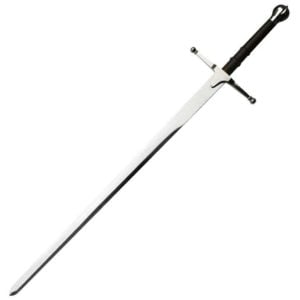

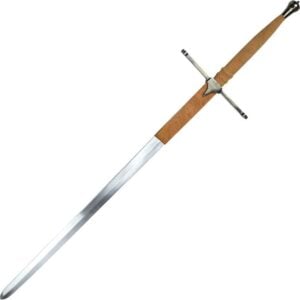

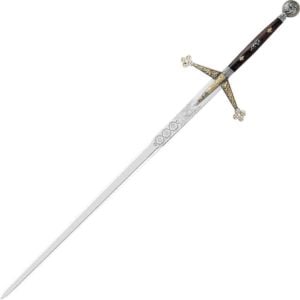
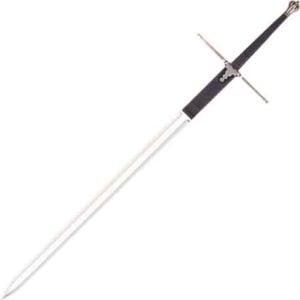

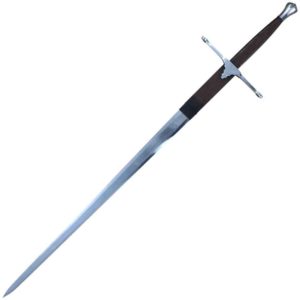

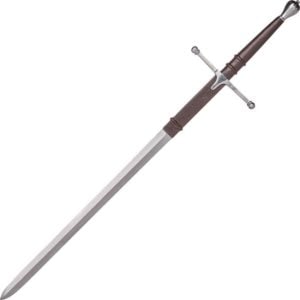

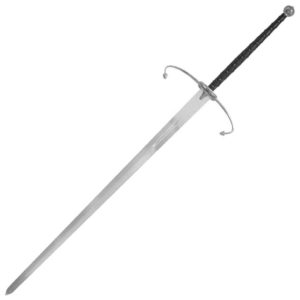
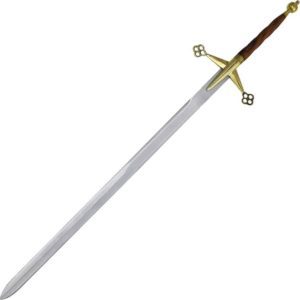

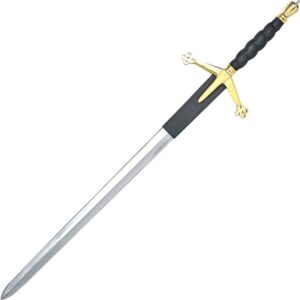

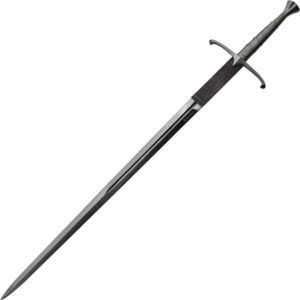

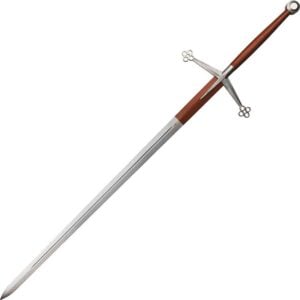
Claymore swords are among the most recognized weapons in history. The Claymore is a large, two-handed greatsword with a fearsome reputation. Claymore is derived from the Gaelic “claidheamh-mor,” meaning “great sword.” This large sword or greatsword was first used to describe the weaponry with cross-hilts used in the Scottish Highlands by warriors and mercenaries in Ireland from the late 15th to early 17th century. These early claymores typically sported a blade length of around 55 inches, making them highly effective in battle.
Several Scottish literary references indicate that Gaelic speakers applied the term “claymore” to the old-fashioned, two-handed swords and the characteristic basket-hilted swords of the early 18th century. Since these armaments were so massive, the people wielding them needed no shield. The sheer blade width and length also prevented highland fighters from supporting each other, unlike the Roman tactic of locking shields and holding their infantry lines. The claymore became a favorite battle weapon in Scotland because it had a fearsome reputation on the battlefield, known to slice through ranks of enemies.
Frequently Asked Questions
What is a claymore sword?
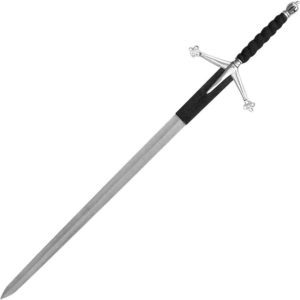
A claymore is a large, two-handed sword that originated in the Scottish Highlands and became one of the most recognizable bladed weapons in history. The name comes from the Scottish Gaelic phrase “claidheamh mor,” which translates directly to “great sword.” The classic Highland claymore is characterized by a long double-edged blade, a cross hilt with forward-angling quillon arms, and distinctive quatrefoil terminals at the ends of those quillons. It was the primary weapon of Scottish Highland warriors from roughly the late 15th through the early 17th centuries. A second type, the basket-hilted broadsword, also came to be called a claymore during the 18th century and remained in service with Scottish military officers into the modern era.
How big is a claymore sword?
Historical claymores were notably large even by the standards of European two-handed swords. The average two-handed Highland claymore measured approximately 55 inches in overall length, with a blade of around 42 inches and a grip of roughly 13 inches. The crossguard width on many examples stretched to about 12 to 13 inches as well. Replica claymores sold today generally stay close to those proportions, though dimensions vary by maker and style. Our collection includes pieces that reflect the full range of historical sizing.
How much does a claymore sword weigh?
A historically accurate two-handed claymore typically weighed between 4.5 and 6 pounds, with 5.5 pounds being a commonly cited average. Despite their imposing size, claymores were not as cumbersome as they might appear. Bladesmiths of the era understood balance deeply, and a well-made claymore distributes its weight in a way that makes it manageable for a trained fighter. The largest claymore on historical record measures over seven feet and weighs approximately 23 pounds, but that piece is an outlier. The functional and decorative replicas in our collection are built to authentic weight specifications so they feel correct in hand.
What is the difference between a claymore and other two-handed swords?
The Highland claymore has a few features that set it apart from continental European greatswords and longswords. The most distinctive is the crossguard design: the quillons angle forward toward the blade rather than sitting perpendicular to it, and each arm terminates in a quatrefoil, which is a four-lobed clover-like decoration. Claymores also typically feature langets, which are metal strips running from the guard down the flat of the blade to reinforce that section. The pommel is usually a wheel or disk shape, sometimes finished with a crescent-shaped nut. Compared to a German Zweihander or an Italian great sword, the claymore tends to be somewhat shorter and lighter while sharing the same two-handed fighting style.
What is a “ricasso” on a claymore, and why does it matter?
The ricasso is an unsharpened section of the blade directly above the guard. On a claymore, this section is often long enough for a fighter to grip with one hand, effectively shortening the weapon for close-quarters combat. This grip technique, sometimes called half-swording, gave the wielder more control in tight situations and allowed for precision thrusts. When shopping for a claymore replica, a visible ricasso is a good indicator that the design is historically informed rather than purely decorative.
What are the two main types of claymore swords?
The two primary types are the two-handed Highland claymore and the basket-hilted broadsword. The two-handed version is what most people picture when they hear the word: a massive, double-edged sword with forward-sloping quillons and quatrefoil terminals, used throughout the clan wars and Scottish conflicts with England from the 1400s through the late 1600s. The basket-hilted broadsword came into widespread use during the 17th and 18th centuries and features a one-handed grip enclosed by an iron cage or basket that protects the hand. Both styles are sometimes referred to as claymores, and both are available in our collection.
What are claymore swords used for today?
Today, claymore swords serve a wide range of purposes. Decorative claymores are popular for wall display, home decor, and as centerpieces in Scottish or medieval-themed collections. Functional, battle-ready claymores are used in historical reenactments, SCA (Society for Creative Anachronism) combat, stage and film productions, and Western martial arts (HEMA) practice. Stainless steel decorative versions are a popular choice for costumes and cosplay. Many buyers also purchase claymores as gifts for history enthusiasts, people with Scottish heritage, or fans of Scottish-themed films and games. Our collection includes options suited for every one of these uses.
What steel types are used in claymore replicas, and what is the difference?
The two most common steels used in sword replicas are high-carbon steel and stainless steel, and they serve different purposes. High-carbon steel, such as 1075, 1095, or 5160, is used in functional and battle-ready claymores. It is tougher and more flexible than stainless steel, which means it can absorb impacts without shattering, making it safe for actual use in combat practice, reenactment, or cutting exercises. Stainless steel is harder but more brittle under stress, making it well-suited for display purposes but generally not recommended for sparring or contact use. If you intend to use your claymore for anything beyond display, look for a high-carbon steel blade with a full tang.
What is a “full tang,” and why does it matter when buying a claymore?
The tang is the portion of the blade that extends into the handle. A full tang runs the entire length of the grip and is secured by the pommel, making it the strongest possible construction. A partial or “rat-tail” tang is narrower and may only extend partway into the handle, which can result in the blade working loose under stress. For any functional claymore intended for reenactment, sparring, or heavy use, a full tang is a critical feature to look for. Decorative display pieces can use a partial tang without issue since they will not be subjected to physical stress.
What is the difference between a decorative claymore and a battle-ready one?
A decorative claymore is built primarily for visual appeal. These swords typically feature ornate finishing, polished or mirror-bright blades, and may include engraved or etched details. They are made to be displayed and admired rather than used. A battle-ready or functional claymore is built to perform. It uses high-carbon steel, a full tang construction, and proper heat treatment and tempering. The blade may be sharpened or unsharpened depending on the intended use, and the overall construction prioritizes durability over decorative finish. Many buyers in our collection choose battle-ready claymores for reenactment even if they also intend to display them, since functional quality is rarely at odds with a handsome appearance.
What should I look for in a claymore for historical reenactment?
For historical reenactment, particularly in groups like the SCA or HEMA communities, look for a high-carbon steel blade, a full tang, and a blade that is blunted or rebated (meaning the edge is rolled rather than sharp, for safety in live combat). Confirm the weight and balance point are appropriate for your skill level and fighting style. Many reenactment organizations have specific equipment standards, so it is worth reviewing those before purchasing. You will also want a robust crossguard and a securely attached pommel. Brands like Hanwei, Windlass Steelcrafts, and Darksword Armoury are well-regarded in the reenactment community for producing historically informed, durable replicas.
Can I use a claymore sword for LARP events?
For LARP events where live-contact combat takes place, a traditional steel claymore is not appropriate since contact weapons must be foam or latex to prevent injury. However, LARP-specific foam claymores are available and made to closely resemble the look of a Highland greatsword while being safe for full-contact play. For non-contact costuming, display, or photo purposes at LARP events, a steel decorative or functional claymore is perfectly suitable. Medieval Collectibles carries options across the full spectrum from foam LARP weapons to fully functional steel replicas.
Is a claymore a good choice for someone new to collecting historical swords?
Yes, the claymore is one of the most accessible and rewarding first purchases for a new collector. It has genuine historical depth, an instantly recognizable silhouette, strong cultural associations with Scotland and Scottish history, and wide availability at a range of price points. Because it is such a well-documented sword, there is a lot of reliable information available about historical examples to help a new collector understand what they are buying. Starting with a quality decorative or mid-range functional claymore from a reputable manufacturer is a solid entry point into the hobby.
What does a claymore sword typically include when purchased?
This varies by product, but many claymores are sold with a scabbard or sheath, particularly those marketed as display pieces or Scottish heritage replicas. Others are sold blade-only if the intended use is primarily combat training or collection display on a wall mount. Always check individual product listings for inclusions. If a scabbard is not included, we also carry a selection of sword scabbards and display accessories separately.
How should I care for and maintain a claymore sword?
Steel blades, particularly high-carbon steel, require occasional maintenance to prevent rust and surface oxidation. After handling, wipe the blade with a soft, lint-free cloth to remove fingerprint oils, then apply a thin coat of oil (mineral oil, camellia oil, or a dedicated sword oil) along the blade surface. Store the sword in a dry environment, and if using a leather scabbard, be aware that some leather retains moisture which can cause pitting over time if the blade is stored inside long-term. Stainless steel decorative pieces require less maintenance but benefit from periodic wiping and occasional oil application as well. Avoid touching the blade surface with bare hands more than necessary.
Are the claymores sold by Medieval Collectibles historically accurate?
Our claymore collection spans a range from highly accurate museum-grade reproductions to stylized interpretations inspired by historical forms. Many pieces, particularly those from manufacturers like Hanwei, Windlass Steelcrafts, and Darksword Armoury, are based directly on historical examples held in museums including the Scottish National Museum, the British Museum, and the Royal Armouries in Leeds. Product descriptions specify whether a piece is a reproduction of a specific historical sword or a period-inspired design. If historical accuracy is a priority for you, look for listings that reference a specific original or cite a particular century and region of origin.
What is the connection between the claymore and famous Scottish figures like William Wallace and Robert the Bruce?
Both William Wallace and Robert the Bruce are strongly associated with the greatsword tradition in Scottish history and culture, though the specific swords attributed to them in popular culture are largely the product of legend and cinematic interpretation. The original sword attributed to William Wallace is housed at the National Wallace Monument in Stirling, Scotland. It is a massive two-handed sword, though historians debate how much of the current piece dates to Wallace’s lifetime. The films Braveheart and Outlander, along with a long tradition of Scottish Romantic literature, have solidified the claymore as the defining symbol of Scottish warrior identity. Our collection includes several replicas inspired by these historical figures, including William Wallace and Robert the Bruce sword designs.
What role did the claymore play in Scottish military history?
The claymore was the primary weapon of Highland infantry during the clan wars and the Wars of Scottish Independence, used effectively from roughly the 1400s through the late 1600s. Because of its length and reach, it was particularly effective against lightly armored opponents and cavalry. Highlanders, who typically fought without the locked-shield formations used by Roman-influenced armies, relied on individual fighting prowess and the psychological impact of a charging warrior wielding an enormous blade. The last significant battlefield deployment of the two-handed claymore is generally considered to be the Battle of Killiecrankie in 1689, when Highland forces supporting King James VII routed government troops. After that, the basket-hilted broadsword took over as the primary Scottish military sword, eventually transitioning into a ceremonial role that continues in Scottish regiments today.
How does the claymore appear in modern popular culture?
The claymore has become one of the most recognizable sword archetypes in gaming, film, and television. It appears as a recurring weapon in the Dark Souls video game series, where it is one of the most beloved player weapons. Games like Final Fantasy, For Honor, and Genshin Impact all feature claymore-class weapons. In professional wrestling, WWE star Drew McIntyre carries a claymore sword named Angela as part of his character. The Highlander film franchise made the Scottish greatsword a central symbol of its mythology. Outlander brought the basket-hilted broadsword back into wide cultural awareness. This combination of historical depth and ongoing pop culture relevance makes claymore swords particularly appealing to collectors who came to the hobby through entertainment rather than pure history.
Supporting Statistics
Historical Specifications and Context
The average two-handed Highland claymore measured approximately 55 inches in total length, with a 42-inch blade and a 13-inch grip, based on surviving examples held in major museum collections including the British Museum and the Scottish National Museum. (Source: Arms and Armor; Scotland Kilt Company)
Historical claymores typically weighed between 4.5 and 6 pounds, with most examples clustering around 5.5 pounds, comparable to other European greatswords of the same era. (Source: Multiple sword historians and museum documentation)
The largest claymore on record measures 7 feet 6 inches and weighs 23 pounds, reportedly wielded by a 15th-century Scottish warrior believed to be a member of the Maxwell Clan. Fandom
The claymore was in active military use from the 15th through the 17th centuries, with the last known large-scale battlefield deployment at the Battle of Killiecrankie in 1689. Wikipedia
Many Highland claymores were equipped with imported German blades sourced from blade-making centers such as Solingen and Passau, because Scottish smiths could not meet domestic demand for blades of sufficient quality and size. Swordis
The Highland claymore’s crossguard, featuring forward-angling quillons terminating in quatrefoils, reached its fully developed form by the mid-16th century. (Source: Swordis.com, citing Scottish Arms and Armour by F. Cannan)
The Collector and Replica Market
The global cosplay props market, which includes swords, shields, and armor, was valued at approximately $1.43 billion in 2024 and is forecast to grow at a CAGR of 10.6% through 2033, reaching an estimated $3.56 billion. Weapons, including swords, are the single most sought-after prop category within that market. Dataintelo
Growth in the classical swords and weapons market is being driven by rising interest in historical reenactments and cosplay, expanding martial arts schools, and the growing popularity of medieval-themed films and television series. Data Insights Market
Metal-based props and replicas, particularly swords and armor, are the preferred choice among serious cosplayers and collectors due to their superior quality and durability, and demand for metal products in the costume and collectibles market is expected to grow as more consumers seek premium, long-lasting items. Dataintelo
Historical dress and historically inspired costumes are projected to account for a significant share of the global cosplay clothing market, which is expected to reach $9.2 billion by 2035 from $5.4 billion in 2025. Future Market Insights
Scottish Heritage and Cultural Context
The global heritage tourism market was valued at $19.8 billion in 2024 and is projected to reach $45.6 billion by 2035 at a CAGR of 7.8%, driven in part by rising consumer interest in cultural heritage experiences including medieval castle stays, clan history, and historical sites across Scotland. Future Market Insights
Approximately 33 million Americans claim Scottish or Scots-Irish ancestry, representing one of the largest European heritage communities in the United States. This population represents a core market for Scottish historical replicas, clan-connected swords, and heritage collectibles. (Source: U.S. Census Bureau heritage estimates)
Following the Jacobite uprisings and the Battle of Culloden in 1746, the British Crown banned Highland arms including the claymore. That prohibition helped transform the claymore from an active weapon of war into a romanticized national symbol, a status reinforced by 19th-century writers like Sir Walter Scott and carried through to the present day. True Swords
The claymore appears as a significant weapon in multiple top-selling video game franchises including Dark Souls, Final Fantasy, Genshin Impact, and For Honor, and has been prominently featured in major films and television series including Braveheart, Highlander, and Outlander, sustaining strong ongoing consumer interest in claymore replicas across multiple buyer demographics.