
Museum-Quality Replicas: A Collector’s Guide to Premium Historical Reproductions
Home » Glossary » Collecting & Replicas Hub » Types of Replicas: Understanding Replica Categories for Collectors » Museum-Quality Replicas: A Collector’s Guide to Premium Historical Reproductions
Museum-Quality Replicas: A Collector's Guide to Premium Historical Reproductions
Table of Contents
Introduction
Among the hierarchy of historical reproductions available to collectors, museum-quality replicas represent the pinnacle of craftsmanship, research, and authenticity. These exceptional pieces transcend ordinary reproductions by faithfully recreating not just the appearance but the materials, construction methods, weight, balance, and functional characteristics of original historical artifacts. For serious collectors, historians, and institutions, museum-quality replicas offer a tangible connection to the past that standard decorative pieces simply cannot provide.
The term “museum-quality” carries significant weight in the collecting community. Unlike mass-produced decorative items or even functional battle-ready pieces, true museum-quality reproductions are created through meticulous research, often involving direct study of original artifacts held in museum collections worldwide. These pieces serve not only as collector’s items but also as important educational tools, allowing researchers to understand how historical weapons and armor functioned in ways that handling fragile originals would never permit.
The creation of museum-quality replicas requires a convergence of historical scholarship, traditional craftsmanship, and premium materials. Master craftsmen who produce these pieces typically spend years developing their skills and building relationships with museum curators, academics, and fellow artisans. The result is a category of historical reproduction that stands apart from all others—pieces that could, in many cases, be displayed alongside originals without an untrained eye detecting the difference.
What Defines Museum-Quality?
The designation “museum-quality” is not merely a marketing term but represents a specific standard of excellence in historical reproduction. According to principles established by organizations such as the International Council of Museums (ICOM), replicas that meet museum standards must achieve authenticity in both form and function while being clearly identifiable as reproductions to prevent confusion with genuine artifacts.
Core Characteristics
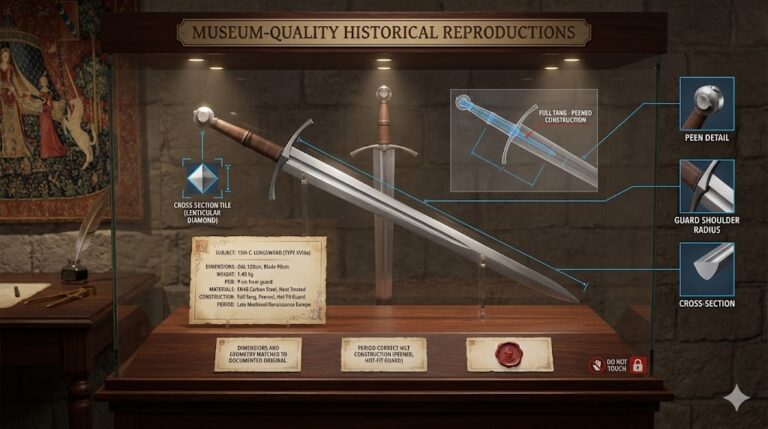
A genuine museum-quality replica exhibits several defining characteristics that distinguish it from lesser reproductions. First and foremost is historical accuracy—every dimension, curve, and detail must correspond to documented historical examples. This requires extensive research into surviving artifacts, period illustrations, archaeological finds, and contemporary written descriptions. The Metropolitan Museum of Art’s Arms and Armor Department, which houses approximately fourteen thousand objects, serves as one of many authoritative sources for researchers seeking to create accurate reproductions.
Beyond visual accuracy, museum-quality pieces must replicate the handling characteristics of historical originals. For weapons, this means achieving the correct weight, balance, and point of percussion. For armor, it requires proper articulation, range of motion, and protective geometry. These functional aspects were essential to the original pieces’ purpose and must be faithfully reproduced for a replica to truly merit the museum-quality designation.
The Distinction from Other Categories
Understanding what separates museum-quality replicas from other categories helps collectors make informed decisions. Decorative replicas, the most common and affordable category, prioritize visual appeal over authenticity. These pieces often use stainless steel blades with rat-tail tangs, cast metal fittings, and simplified construction methods. While suitable for wall display, they bear little resemblance to historical originals in terms of materials or construction.
Battle-ready or functional replicas represent a middle tier, constructed from appropriate materials such as high-carbon steel and featuring full tangs. These pieces can withstand actual use in cutting practice or reenactment. However, they may not precisely replicate specific historical examples, instead offering generalized representations of period types. Museum-quality pieces go further by recreating exact historical swords or armor pieces down to the finest details, based on hands-on study of originals.
Standards and Criteria
The production of museum-quality replicas adheres to rigorous standards that parallel those used in museum conservation. The International Institute for Conservation of Historic and Artistic Works (IIC) maintains guidelines that inform how cultural heritage objects should be preserved, documented, and replicated. These principles extend to high-quality reproductions, ensuring that replicas serve legitimate educational and preservation purposes.
Research Requirements
Creating a museum-quality replica begins with exhaustive research. This typically involves direct examination of original artifacts, measurement of dimensions and weights, analysis of construction techniques, and study of metallurgical compositions. Leading craftsmen often travel to museums worldwide to handle and study originals, taking detailed measurements and photographs that inform their reproductions.
Documentation is equally critical. Reputable producers of museum-quality replicas maintain detailed records of their research sources, including the specific museum pieces that served as models, academic publications consulted, and any collaboration with scholars or curators. This documentation accompanies the finished piece, providing collectors with provenance for their acquisition.
Construction Standards
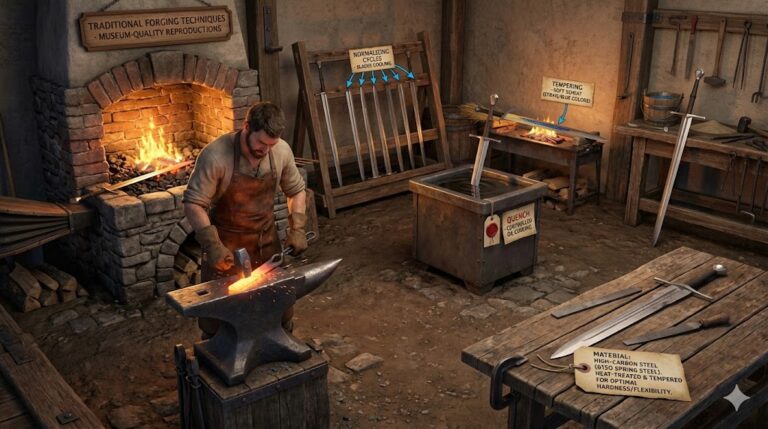
Museum-quality construction demands the use of historically appropriate materials processed through period-correct or equivalent methods. For European swords, this typically means blades forged from high-carbon steel, heat-treated to achieve properties comparable to historical examples. The Albion Swords company, widely regarded as setting the standard for museum-quality European sword reproductions, uses 6150 spring steel that is heat-treated and tempered to achieve optimal hardness and flexibility.
For armor, museum-quality standards require appropriate steel gauges—typically 14 to 18 gauge depending on the piece and historical period—with proper shaping, articulation, and finishing. The work of armorer Nigel Carren exemplifies these standards, producing pieces using period techniques that have been displayed at institutions including The Imperial War Museum London.
Materials and Construction
The materials used in museum-quality replicas distinguish them fundamentally from lesser reproductions. Rather than compromising with modern substitutes, master craftsmen seek materials that closely match or are identical to those used historically, while meeting modern standards for quality and safety.
Steel for Blades and Armor
High-carbon steel forms the foundation of museum-quality weapons and armor. For sword blades, steels in the 1060 to 1095 carbon range or spring steels like 5160 and 6150 provide the combination of hardness, flexibility, and edge retention that historical smiths achieved through careful forge-welding and heat treatment. The sword collecting community recognizes that proper heat treatment is as important as steel composition, requiring precise temperature control and quenching techniques.
For armor reproduction, the choice of steel gauge must balance historical accuracy with practical considerations. Combat-grade reproduction armor typically uses 14-gauge steel for areas requiring maximum protection, such as breastplates and helmets, while lighter 16 or 18-gauge steel serves for components like gauntlets and tassets where flexibility is paramount. The Denver Art Museum’s Higgins Armory Collection provides researchers with examples of historical gauge variations that inform modern reproductions.
Leather and Textiles
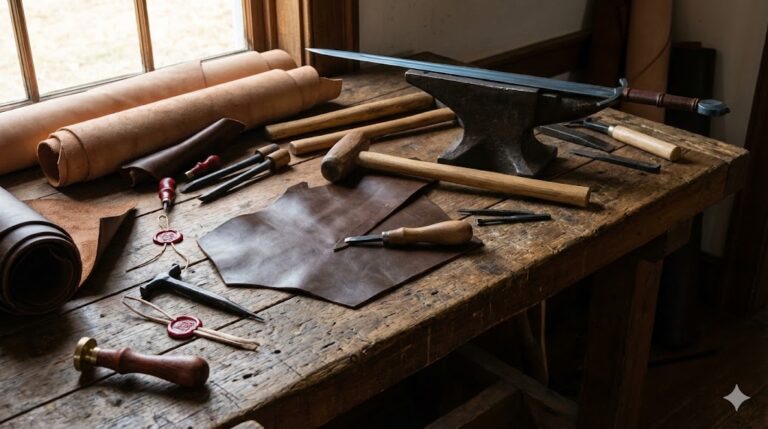
Museum-quality reproductions extend beyond metalwork to include accurate leather and textile components. Vegetable-tanned leather, processed using methods dating back centuries, provides the authentic look, feel, and aging characteristics appropriate for scabbards, belts, and armor straps. This traditional tanning method produces leather that develops a rich patina over time, unlike chrome-tanned alternatives that remain uniform.
For armor components requiring textile elements—such as arming doublets, mail voiders, or heraldic surcoats—museum-quality standards demand period-appropriate fabrics and construction techniques. This may include hand-stitched seams, naturally-dyed materials, and historically accurate patterns derived from surviving examples or period artwork.
Fittings and Hardware
The fittings on museum-quality pieces receive the same attention as primary components. Sword hilts may feature hand-carved wooden grips wrapped in cord or leather, pommel and guard assemblies machined or forged to exact specifications, and hardware in bronze, brass, or iron as historically appropriate. Cast fittings, common on decorative pieces, are typically avoided in favor of forged or machined components that better replicate historical methods.
Research and Documentation
The foundation of any museum-quality replica is thorough academic research. Leading craftsmen approach their work with the same rigor as museum curators, building reference libraries, cultivating relationships with scholars, and maintaining detailed documentation of their research methodology.
Primary Sources
Creating an accurate replica requires access to primary sources—the original artifacts themselves. Peter Johnsson, the sword historian and designer whose work forms the basis of Albion’s Museum Line, conducts hands-on research spanning museums worldwide. This direct study allows craftsmen to capture subtle details that photographs cannot convey: the exact feel of a grip’s shape, the precise distal taper of a blade, or the way components fit together.
Major collections that serve as research sources include the Metropolitan Museum of Art in New York, the Royal Armouries in Leeds, the Wallace Collection in London, and the Kunsthistorisches Museum in Vienna. Tod of Tod’s Workshop exemplifies this approach, personally measuring and handling pieces from the Wallace Collection and British Museum to ensure his reproductions achieve exacting accuracy.
Academic Collaboration
Museum-quality reproduction involves collaboration with academic specialists. Sword historian Ewart Oakeshott, whose typological system remains the standard for classifying medieval European swords, worked closely with reproduction craftsmen to ensure accuracy. Similarly, modern scholars continue to consult with leading reproduction makers, providing expertise in metallurgy, art history, and material culture.

Documentation and Certificates
Reputable producers of museum-quality replicas provide comprehensive documentation with each piece. This typically includes information about the historical original that served as the model, the museum or collection where it resides, relevant catalog or accession numbers, and any academic publications that informed the design. Some manufacturers issue certificates of authenticity detailing materials, construction methods, and the craftsman responsible for the work.
Notable Craftsmen and Manufacturers
The museum-quality replica market is served by a relatively small number of highly skilled craftsmen and specialized manufacturers whose reputations have been built over decades of meticulous work. Understanding who produces genuine museum-quality pieces helps collectors navigate a market that includes many who misuse the term.
European Sword Reproductions
Albion Swords, founded by Howard and Amy Waddell in New Glarus, Wisconsin, has established itself as the benchmark for museum-quality European sword reproductions. Their Museum Line consists of exact recreations of specific historical swords held in museums, designed by Peter Johnsson based on his hands-on research. Each blade is computer-assisted machined to precise specifications, then finished by hand to achieve the exact geometry, weight, and balance of the original.
Arms and Armor of Minnesota has produced historically accurate European weapons for over four decades, working with museums, collectors, and scholars. Their pieces range from production models to fully custom commissions based on specific historical examples. The company maintains relationships with curators and academics that inform their designs.
Tod’s Workshop in the United Kingdom produces museum-quality medieval weapons including swords, daggers, and crossbows. With over 25 years of experience, Tod Todeschini creates pieces based on artifacts in the Wallace Collection, British Museum, and other major institutions. His scabbards, made with period-correct construction techniques and materials, are particularly renowned.
Armor Reproductions
Nigel Carren produces museum-quality armor using only period techniques and the highest quality materials. His work has been displayed at The Imperial War Museum and used in major film productions. As both a collector and craftsman, Carren brings a unique perspective to reproduction work, understanding the discerning eye that collectors bring to evaluating pieces.
Historic Enterprises, led by Jeffrey Hedgecock, produces custom armor and weapons that have been acquired by institutions including the Royal Armouries Museum and the Frazier Historical Arms Museum. Hedgecock personally studies pieces using his extensive reference library and museum visits, and uniquely among armor makers, tests his reproductions in competitive jousting.

Japanese Arms Reproductions
For Japanese weapons, museum-quality traditionally refers to pieces created by certified swordsmiths using traditional tamahagane steel and centuries-old forging techniques. Organizations such as the Nihon Bijutsu Token Hozon Kyokai (NBTHK) maintain standards for both antique authentication and modern sword production. Iron Mountain Armory produces traditional samurai armor at various quality levels, with their Taisho Class representing museum-quality work researched from actual armor in private collections and museums.
Authentication and Provenance
While authentication primarily concerns antique artifacts rather than acknowledged reproductions, the concept of provenance remains important for museum-quality replicas. Understanding the research basis, craftsman credentials, and documentation that accompany a piece helps establish its legitimacy as a museum-quality reproduction.
Certificates and Documentation
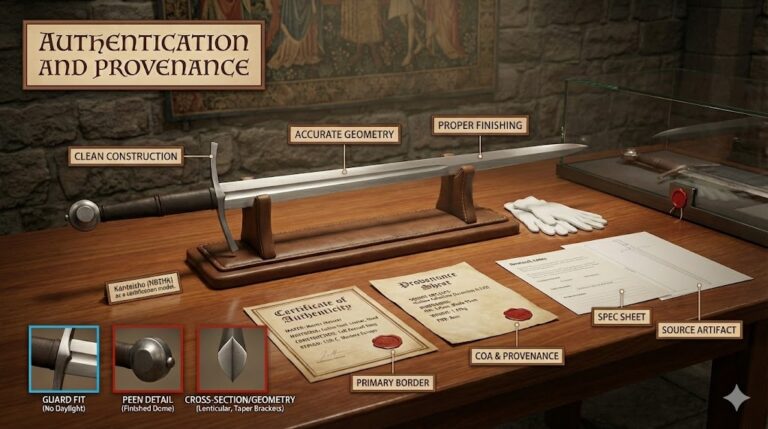
Legitimate museum-quality reproductions should include documentation establishing their pedigree. For pieces based on specific museum artifacts, this includes identification of the original (museum name, accession or catalog number), the craftsman or company that produced the replica, materials used, and construction methods employed. Some manufacturers provide formal certificates of authenticity, particularly for limited edition or custom pieces.
The Japanese sword world offers instructive parallels. Authentication papers (kanteisho) issued by organizations like the NBTHK significantly impact value and provide detailed information about blade characteristics. While Western reproduction swords lack equivalent formal certification systems, collectors should expect comparable documentation from reputable producers.
Recognizing Quality
Beyond documentation, collectors can evaluate museum-quality claims by examining the piece itself. Hallmarks of authentic museum-quality work include clean, robust welds and seams; appropriate blade geometry including proper distal taper; historically accurate proportions verified against published research; quality of finishing commensurate with stated materials; and proper weight and balance characteristics.
Red Flags
Collectors should be wary of pieces marketed as “museum-quality” that exhibit warning signs: prices significantly below established market rates for comparable work; vague claims about historical basis without specific documentation; visible shortcuts such as cast fittings on supposedly forged pieces; and lack of transparent information about the maker or their credentials. As with any significant acquisition, research into the producer’s reputation within the collecting community provides valuable insight.
The Role of Experimental Archaeology
Museum-quality replicas serve purposes beyond collecting, playing important roles in experimental archaeology—a field that uses reproduction artifacts to test hypotheses about historical technologies and practices. This academic application further validates the importance of accuracy in museum-quality work.
Understanding Historical Weapons
The Bronze Age Combat Project, led by researchers including Andrea Dolfini at Newcastle University, demonstrates how replica weapons contribute to academic understanding. By conducting controlled combat experiments with authentic replica Bronze Age swords, the project generated wear marks that matched those found on archaeological specimens, providing new insights into prehistoric combat techniques.
Similarly, research published in the Journal of Archaeological Method and Theory combined experimental archaeology with metalwork wear analysis to understand how Bronze Age warriors actually used their weapons. These studies relied on museum-quality replicas accurate enough to produce meaningful data when subjected to realistic use.
Historical European Martial Arts
The Historical European Martial Arts (HEMA) community depends on museum-quality reproductions for practical study of historical fighting techniques. Practitioners reconstructing combat styles from medieval and Renaissance treatises require swords with historically accurate weight, balance, and handling characteristics to understand how the documented techniques actually functioned. Manufacturers like Albion recognize this market, producing both their exacting Museum Line and more affordable practice-oriented pieces.

Educational Applications
Museums themselves commission high-quality replicas for educational purposes. Original artifacts are often too fragile or valuable to handle, but museum-quality reproductions allow visitors and researchers to experience the weight, balance, and feel of historical objects. The conservation guidelines from organizations like the American Institute for Conservation recognize replicas as legitimate tools for protecting originals while maintaining educational value.
Evaluating Museum-Quality Pieces
For collectors considering museum-quality acquisitions, systematic evaluation helps ensure that pieces merit the designation and justify their premium pricing. This evaluation encompasses research verification, physical examination, and assessment of the maker’s credentials.
Research Verification
Begin by verifying the claimed research basis for any museum-quality piece. If the manufacturer identifies a specific museum artifact as the model, confirm that artifact exists in the stated collection. Academic publications, museum catalogs, and reference works like Oakeshott’s Records of the Medieval Sword can corroborate claims. Reputable manufacturers welcome such verification and often provide detailed information about their research methodology.
Physical Examination Checklist
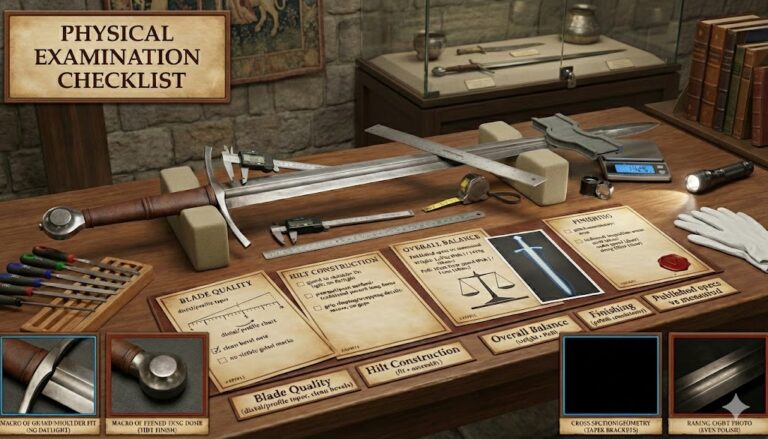
When examining a prospective acquisition, consider the following criteria:
Blade Quality: Examine for consistent taper (both distal and profile), clean bevels, absence of visible grind marks, and proper heat treat evidenced by hardness testing if possible. Museum-quality blades should exhibit the precise geometry documented for their historical model.
Hilt Construction: Assess guard and pommel fit, grip shaping and wrapping, and the method of hilt assembly. Components should fit precisely with minimal gaps. Cast fittings are generally inappropriate for museum-quality work unless historically documented.
Overall Balance: Evaluate weight and balance against published specifications for the historical original. Museum-quality reproductions should handle similarly to their models, with point of balance and dynamic characteristics that match documented measurements.
Finishing: Examine surface finish for consistency and quality. Note any tool marks, polishing inconsistencies, or shortcuts in areas less visible during casual inspection. Museum-quality work maintains high standards throughout, including areas typically unseen.
Maker Credentials
Research the reputation of the craftsman or manufacturer within the collecting community. Established makers have track records documented through collector reviews, forum discussions, and in some cases, academic citations. New or unfamiliar sources warrant additional scrutiny before significant purchases. The sword collecting community actively discusses maker quality on forums and social media, providing valuable peer insight.
Investment Considerations
Museum-quality replicas represent significant investments, with prices typically ranging from several hundred to several thousand dollars depending on the item type, maker, and complexity. Understanding the factors that influence pricing and potential value retention helps collectors make informed decisions.
Pricing Factors
Several factors influence museum-quality replica pricing. Labor intensity is primary—a complex sword requiring weeks of hand finishing commands higher prices than simpler designs. Material costs play a role, particularly when makers use premium steel alloys, precious metal fittings, or authentic leather and textiles. Research and development costs, including travel to study originals and consultation with scholars, factor into pricing for pieces based on newly-studied artifacts.
Limited production also affects pricing. Unlike mass-produced decorative pieces, museum-quality replicas often come from small workshops with limited output. Albion’s Museum Line pieces, for example, have historically had wait times exceeding one year due to the careful handwork required. This scarcity, combined with collector demand, supports premium pricing.
Value Retention
Museum-quality replicas from established makers generally retain value well within the collecting community. Pieces from defunct makers or limited editions may appreciate over time as supply becomes fixed while demand continues. However, collectors should acquire primarily for personal appreciation rather than speculation—the secondary market for even high-quality reproductions is smaller and less liquid than for antiques.
Proper care and documentation support value retention. Maintaining pieces in good condition, preserving original packaging and certificates, and documenting provenance all contribute to resale value should collectors later choose to sell.
Budget Considerations
For collectors building a collection, museum-quality pieces often represent the culmination rather than the starting point. Many experienced collectors recommend beginning with quality battle-ready pieces to develop appreciation and handling skills before investing in premium museum-quality work. This progression allows collectors to develop the discernment needed to evaluate museum-quality claims and make informed acquisition decisions.
See Also
- Functional vs. Decorative Replicas
- Battle-Ready Replicas
- Identifying Quality Replicas
- Steel Quality Indicators
- Red Flags in Poor Quality Replicas
- Licensed Fantasy Replicas
- Understanding Replica Values
- Historical European Martial Arts (HEMA)
References
- Metropolitan Museum of Art. “Arms and Armor.” https://www.metmuseum.org/about-the-met/collection-areas/arms-and-armor
- Wikipedia. “Replica.” https://en.wikipedia.org/wiki/Replica
- International Council of Museums. “Original, Copy, Fake: On the Significance of the Object in History and Archaeology Museums.” https://icom.museum/wp-content/uploads/2018/07/Actes-Shanghai-complet2.pdf
- International Institute for Conservation. “Conservation Standards and Guidelines.” https://www.iiconservation.org/conservation-standards-and-guidelines
- Albion Swords. “About Albion.” https://albion-swords.com/
- Wikipedia. “Albion Swords.” https://en.wikipedia.org/wiki/Albion_Swords
- Tod’s Workshop. “Historical Swords, Daggers, Crossbows.” https://todsworkshop.com/
- Carren, Nigel. “Historic European Armour Reproductions.” https://www.nigelcarren.co.uk/reproduction-armour
- Arms & Armor. “About Us.” https://www.arms-n-armor.com/
- Historic Enterprises. “Custom Armour Gallery.” https://historicenterprises.com/arms-and-armour-c-101/armour-custom-work-c-101_133/
- Metropolitan Museum of Art. “Famous Makers of Arms and Armors and European Centers of Production.” https://www.metmuseum.org/toah/hd/make/hd_make.htm
- Metropolitan Museum of Art. “The Decoration of European Armor.” https://www.metmuseum.org/essays/the-decoration-of-european-armor
- Denver Art Museum. “Age of Armor Access Guide.” https://www.denverartmuseum.org/en/age-armor-access-guide
- Hermann, R., et al. “Bronze Age Swordsmanship: New Insights from Experiments and Wear Analysis.” Journal of Archaeological Method and Theory (2020). https://link.springer.com/article/10.1007/s10816-020-09451-0
- BAR Publishing. “Bronze Age Combat: An Experimental Approach.” https://www.barpublishing.com/bronze-age-combat.html
- Wikipedia. “Experimental Archaeology.” https://en.wikipedia.org/wiki/Experimental_archaeology
- Farrell, Keith. “Hit and Miss: Historical Weapon Systems, Experimental Archaeology, and Synthesis.” https://www.keithfarrell.net/blog/2019/03/hit-and-miss-historical-weapon-systems-experimental-archaeology-and-synthesis/
- Archaeology Magazine. “Experimental Study Investigates Marks on Bronze Age Weapons.” https://archaeology.org/news/2024/10/10/experimental-study-investigates-marks-on-bronze-age-weapons/
- Tozando. “Japanese Sword Certificate Guide.” https://japanesesword.net/blogs/news/how-to-obtain-a-japanese-sword-certificate-a-complete-guide
- Iron Mountain Armory. “About Our Samurai Armor & Traditional Crafting.” https://ironmountainarmory.com/crafting-samurai-armor/
- American Institute for Conservation. “Exhibit Conservation Guidelines.” http://resources.culturalheritage.org/wp-content/uploads/sites/8/2015/02/osg007-02.pdf
- AIC Wiki. “Replacing Collection Objects.” https://www.conservation-wiki.com/wiki/Replacing_Collection_Objects