
War Hammers
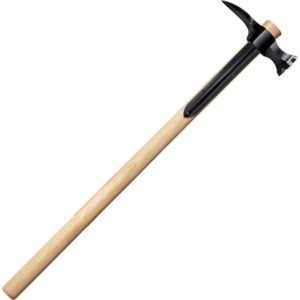


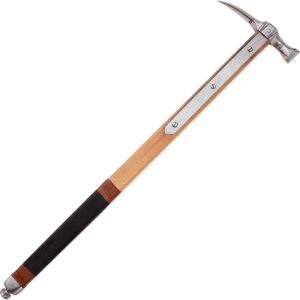
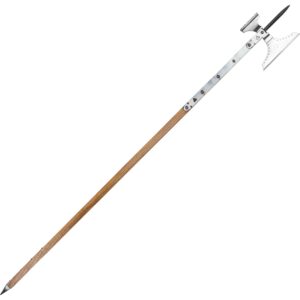
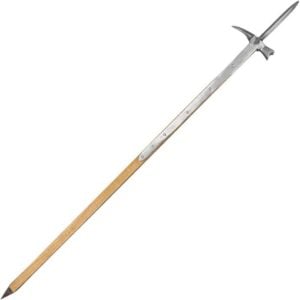
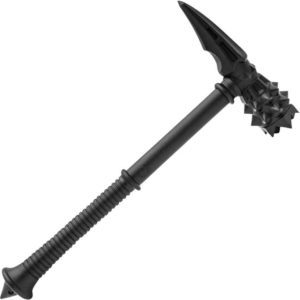
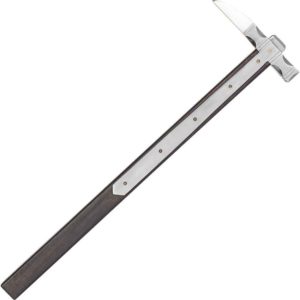
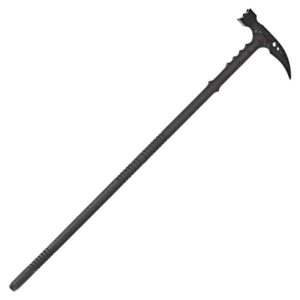

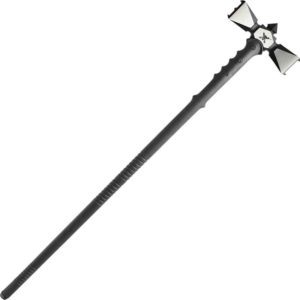
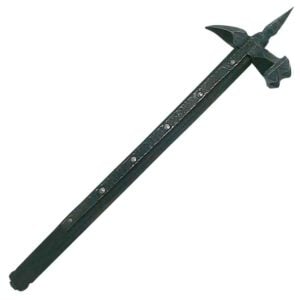

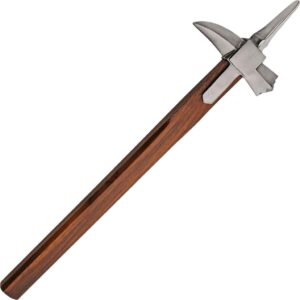
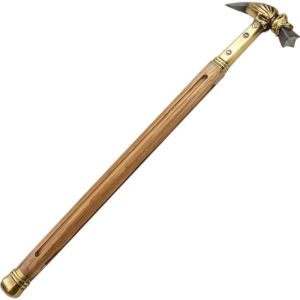


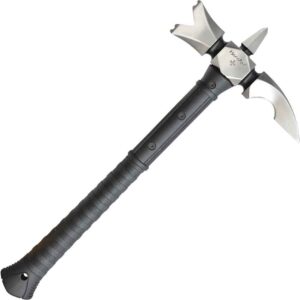


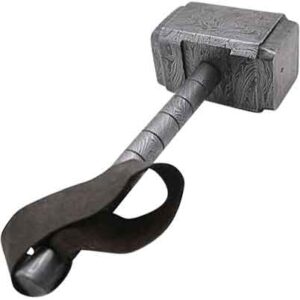


A war hammer is a development of the late thirteenth century created specifically to deal with heavy plate-style armour. The massive hammerhead of a medieval war hammer could crush the strongest helmet or suit of plate armor with just a few blows, and the back spike could rip through the helm and plate like a modern can opener.
In battle, the blunt side of the hammerhead was usually employed first to knock down and stun an enemy. Once he was on the ground, helpless, the polearm was reversed, and the back spike was used to punch a hole through the helmet and deliver the coup de grace.
Here at Medieval Collectibles, we can supply your games with fully functional German and English war hammers and foot soldier war hammers.
Brief History of the War Hammer
The war hammer was a commonly used weapon in the late Medieval period and has become a popular modern-day armament for games. Two variations of these hammers were the long and short war hammers. The long one, also known as a maul, was considered a polearm, meant to dismount mounted opponents. The short one was used during close combat.
The weapon was shaped like a typical hammer but was built to inflict damage upon an armored foe. The head had a blunt side and a spiked edge on either end. It was mounted on a pole handle that measured from one foot to five feet long.
The heavy nature of these hammers and their suitability as weapons against plate armor made them a popular weapon type in games.
Frequently Asked Questions
Why was the war hammer invented?
The war hammer was developed specifically to counter the advances in plate armor technology that took hold in Europe during the 14th century. As armorers began producing surface-hardened steel plates that covered more and more of the body, bladed weapons like swords and axes became significantly less effective. A sword blade striking curved, hardened plate was likely to glance off rather than penetrate, losing most of its impact. The war hammer solved that problem by delivering blunt force that could travel through the armor itself, causing concussions or skeletal damage even without puncturing the steel. The spiked or beaked side added a piercing option for targeting gaps and weak points in the plate. In this way, the war hammer and plate armor essentially evolved together in an arms race that defined late medieval combat.
What are the main types of war hammers available?
Several distinct types of war hammers developed across medieval Europe, each suited to specific combat roles. The standard short war hammer was a one-handed cavalry weapon, light and fast enough to use on horseback while still capable of punching through armor. The long war hammer, also called a pole hammer or maul, was a two-handed infantry weapon mounted on a shaft as long as five to six feet, providing reach and tremendous leverage for dismounting riders. The Lucerne hammer, developed by the Swiss, featured a three or four-pronged head and an extended top spike mounted on a long pole, making it effective both as a striking and thrusting weapon. The bec de corbin, from the Old French for “raven’s beak,” prioritized the curved rear beak for tearing and hooking through plate rather than the hammer face. The Venetian war hammer combined a hammer head, rear spike or beak, and a spear tip into a single multipurpose polearm. Our collection at Medieval Collectibles includes examples of these historical types as well as fantasy-inspired interpretations of the form.
What is the difference between a war hammer and a mace?
Both weapons were developed to deal with armored opponents, but they work differently and evolved along separate lines. A mace has a shaft topped by a flanged or spiked metal head designed primarily to deliver blunt crushing blows over a broader impact area. A war hammer is distinguished by its asymmetrical head: a flat or pronged hammer face on one side and a spike or beak on the other. The hammer face concentrates force onto a smaller surface area than a mace head, making it more effective at driving through the curved surfaces of a helmet or breastplate. The beak gives the war hammer a versatile piercing and hooking capability that a mace typically lacks. Historically, war hammers were generally considered somewhat lighter and faster than maces of comparable size, making them a popular choice for cavalry who needed to maneuver quickly on horseback.
What is a Lucerne hammer?
The Lucerne hammer was a specialized polearm developed by Swiss infantry fighters, named for the city of Lucerne where it originated. It features a head divided into three or four pronged points rather than a single flat face, which allowed it to grip and bite into the curved surfaces of plate armor instead of sliding off. A long, thin spike extends from the top of the head for thrusting, and a sturdy rear beak provides a hooking and tearing function. The entire assembly is mounted on a shaft of approximately seven feet, giving infantry soldiers the reach to engage mounted knights and pull riders from their horses. The Lucerne hammer was particularly popular among 15th and 16th century Swiss mercenary forces and became associated with Swiss battlefield effectiveness during the Burgundian Wars.
What is a bec de corbin?
The bec de corbin is a type of war hammer polearm whose name translates from Old French as “raven’s beak.” Like the Lucerne hammer, it consists of a modified hammer head mounted atop a long pole, but the bec de corbin emphasizes the rear beak as its primary striking element rather than the hammer face. The beak is typically stouter and more curved than on other war hammers, designed for tearing through plate armor, mail, or padded gambeson. It also features a top spike for thrusting. The hammer face on a bec de corbin is usually blunt and straightforward rather than pronged. The name has sometimes been used loosely to refer to other war hammer types, including the horseman’s pick, and it occasionally appears as a general term for the whole category of polearm war hammers. A surviving example at the Metropolitan Museum of Art in New York, dated to around 1450, is among the most studied specimens in existence.
What is a maul, and how does it differ from a war hammer?
A maul is a long-handled hammer with a very heavy head, typically made of wood, lead, iron, or steel, that functions similarly to a modern sledgehammer. It was one of the earliest polearm hammer weapons used on medieval battlefields, appearing in the late 14th century. Unlike the specialized war hammer with its dual-purpose head, the maul was primarily a blunt-force tool and improvised weapon rather than a purpose-designed military arm. English longbowmen at the Battle of Agincourt in 1415 famously used lead mauls to drive stakes into the ground before battle and then wielded them as close-combat weapons when needed against dismounted French knights. Mauls continued to appear in military records as weapons used by Tudor archers as late as 1562.
How heavy was a medieval war hammer?
Historical war hammers varied in weight depending on their type and purpose. Surviving museum examples and well-documented reproductions generally place the weight of a one-handed short war hammer at around two to three pounds. A Saxon cavalry war hammer at the Metropolitan Museum of Art, dated to the 15th century, weighs 2 lbs. 8 oz. with an overall length of 22.5 inches. Two-handed pole hammers were heavier due to the longer shaft and often larger head, typically ranging from 1.5 to 2.5 kilograms. The balance point and handle length play as much of a role as raw weight in how manageable a war hammer feels in use, and well-constructed replicas like those carried by Cold Steel and Windlass Steelcrafts are built to reflect historically appropriate weight distribution rather than simply maximizing heaviness.
What materials are used in war hammer replicas today?
Modern war hammer replicas sold for collectors and reenactors typically use high-carbon steel for the head, as this provides the toughness and impact resistance needed for functional use. Products like the Cold Steel Medieval War Hammer use 1055 carbon steel with differential heat treatment, hardening the striking surfaces while leaving the rest of the head somewhat softer to absorb shock. Handles are most commonly made from straight-grain hardwoods such as hickory or teak. Langettes, the steel strips running down the shaft below the head, are an important historical feature included on quality replicas to protect the handle from being cut by opposing weapons during combat. Decorative war hammers may use mild steel or Damascus-patterned steel primarily for visual effect rather than functional performance.
What are langettes, and why do they matter on a war hammer?
Langettes are narrow steel strips that run from the weapon head down along the shaft, typically fastened to the wood with rivets. They serve two purposes. First, they reinforce the connection between the head and the shaft, helping the joint resist the torque and impact stress of hard use. Second, they protect the wooden handle from being severed by an opponent’s blade during close-range combat. On a war hammer polearm, where the shaft might be crossing other weapons repeatedly in a fight, this protection was practically essential. Any quality functional or reenactment war hammer should include langettes as both a historical accuracy feature and a structural necessity.
What is the difference between a decorative war hammer and a functional one?
A decorative war hammer is built for display, costume use, and collecting. These pieces prioritize visual appeal, and may use mild steel, Damascus-patterned surfaces, or other materials chosen for their appearance rather than their durability under stress. They are suitable for wall mounting, Renaissance fairs, cosplay, and photo shoots, but are not designed to withstand combat impacts. A functional war hammer is built to be used. It uses high-carbon steel for the head, a robust hardwood handle, proper heat treatment, and structural features like langettes and secure head attachment. Functional pieces are appropriate for historical reenactment, SCA combat training, and HEMA practice. Both types are well represented in our collection, and many buyers find that a mid-range functional war hammer serves admirably as a display piece as well.
Can war hammers be used in LARP events?
For full-contact LARP events, foam or latex war hammers are the appropriate choice, since live steel contact weapons are prohibited at virtually all LARP events for safety reasons. Our LARP war hammer selection includes pieces from top manufacturers like Epic Armoury that are built with durable foam cores, fiberglass shafts for flexibility, and latex outer coatings for realism. These foam war hammers are sculpted and hand-painted with realistic detail and are built to hold up through extended use. For non-combat LARP activities like costuming, photo shoots, and atmospheric roleplay, a decorative steel war hammer works perfectly well alongside other historical gear.
Are war hammers suitable for SCA and HEMA practice?
Yes, provided the piece is built to functional standards. For SCA and Historical European Martial Arts training, you want a war hammer with a high-carbon steel head, a full and securely attached handle, and blunted or rebated striking surfaces where required by your organization’s rules. SCA rules in particular vary by regional group and event type, so it is worth confirming your local chapter’s equipment standards before purchasing. Cold Steel’s war hammer, which features a 1055 carbon steel head and a hickory handle with steel langettes, is a well-regarded option in the reenactment community. Windlass Steelcrafts also produces historically informed functional pieces that meet common reenactment standards.
Why did the war hammer become a symbol of rank and status?
Starting in the 15th century, short cavalry war hammers transitioned from purely functional weapons into symbols of military authority among the lower nobility of eastern and central Europe, particularly in Poland and Hungary. Cavalry commanders known as Rottmeister carried war hammers both as weapons and as insignia of rank, a tradition similar to the way maces served as symbols of authority in western European courts. According to Polish accounts, a nobleman would not leave his home without his saber and his war hammer, which could also serve double duty as a walking stick. This association between the war hammer and martial status helps explain why 15th and 16th century war hammers from Germany and Saxony were often elaborately decorated with etched or inlaid ornament, as seen in several examples held by the Metropolitan Museum of Art.
How does the war hammer appear in modern games and pop culture?
The war hammer is one of the most widely used weapon archetypes in fantasy and gaming culture. The Warhammer tabletop miniature game franchise by Games Workshop takes its name and much of its aesthetic directly from medieval war hammers and blunt-force weapons. The weapon appears prominently in RPG franchises including Dungeons and Dragons, Dark Souls, and Skyrim. Thor’s hammer Mjolnir, one of the most recognizable props in Marvel Cinematic Universe history, draws on the Norse mythological tradition of the divine hammer and has made hammer-type weapons extremely popular across cosplay and collectibles markets. Mjolnir-inspired and Damascus steel decorative hammers sit comfortably in both the Norse mythology collector space and the war hammer collector space, and both are represented in our catalog.
What should I look for when buying a war hammer as a gift?
The right choice depends on what the recipient plans to do with it. For a history enthusiast who wants a display piece, a well-finished decorative war hammer with Damascus or polished steel and an attractive handle makes a striking addition to a collection or home display. For someone involved in reenactment or HEMA, a functional piece from Cold Steel or Windlass with a carbon steel head and hickory handle is a more meaningful gift since they can actually use it. For a gamer, cosplayer, or fantasy fan, a Mjolnir-style Thor hammer or a fantasy-inspired war hammer with dramatic styling will likely resonate more than a strictly historical replica. Our collection covers all of these categories, and most pieces ship with a 30-day return policy.
How do I care for a steel war hammer?
Carbon steel war hammers require routine maintenance to prevent surface rust and oxidation. After handling, wipe the head and any exposed steel with a clean, dry cloth to remove fingerprint oils, then apply a light coat of oil, such as mineral oil, camellia oil, or a dedicated weapon oil, across all steel surfaces. The wooden handle should be kept clean and can be treated periodically with a light application of linseed oil or a similar wood conditioner to prevent drying and cracking. Store the weapon in a low-humidity environment. If the weapon has languets or riveted fittings, check these periodically to ensure they remain secure, particularly if the piece is used for training or reenactment. Stainless steel and mild steel decorative pieces require less maintenance but benefit from the same basic oiling routine.
What other medieval pole weapons pair well with a war hammer collection?
War hammers exist within a broader family of medieval polearms, and collectors who enjoy the hammer category often expand into related weapons. Battle axes share the same general polearm tradition and were used in many of the same tactical roles. Maces offer a close thematic relationship since both were anti-armor blunt weapons. Halberds represent the Swiss and Germanic infantry tradition that gave rise to the Lucerne hammer. Spears and pole weapons more broadly connect to the infantry battlefield where long war hammers were most effective. Medieval Collectibles carries all of these categories, and many of our most engaged collectors build themed displays around the full range of late medieval polearms and concussion weapons.
Historical and Technical Context
The war hammer emerged as a practical military necessity in the late medieval period, when advances in plate armor made swords and axes increasingly ineffective against fully armored opponents. A powerful swing from a war hammer, especially with the spike, can deliver a strike force of several hundred kilograms per square millimeter, equivalent to the penetrating force of a rifle bullet. Wikipedia
Full-fledged war hammers emerged in the mid-14th century as a direct response to the growing prevalence of plate armor on European battlefields. By 1395, French infantry deployed sophisticated war hammers equipped with thrusting tips, side flanges, and a basic beak. These initially single-handed war hammers later evolved into longer two-handed pole hammers that became widespread on European battlefields and also prominent in duels involving armored combatants.Wikipedia
War hammer handles ranged from two to three feet for short one-handed cavalry versions to five or six feet for long polearm versions used by infantry, comparable in length to a halberd.Wikipedia
A Saxon cavalry war hammer at the Metropolitan Museum of Art, dated to around 1450, measures 22.5 inches overall and weighs 2 lbs. 8 oz., illustrating the compact weight profile of historical short war hammers designed for mounted use. (Source: Metropolitan Museum of Art collection records)
At the Battle of Agincourt in 1415, English longbowmen are recorded as using lead mauls, initially as a tool to drive in stakes but later as improvised weapons against dismounted, heavily armored French knights in close combat. Mauls continued to be recorded as weapons used by Tudor archers as late as 1562. Medieval Britain
By the 15th century, cavalry commanders known as Rottmeister carried war hammers both as weapons and as symbols of rank, and Polish accounts record that a nobleman would not leave his house without his saber and his war hammer, which could also serve as a walking stick. Wikipedia
The evolution of plate armor directly triggered the development of war hammers, maces, and pollaxes specifically designed to deliver blunt force trauma through armor. Strong blows to the head from these weapons could result in concussion even if the armor itself was not penetrated. Wikipedia
Replica and Collectibles Market
The global cosplay props market, which includes swords, armor, and weapons such as war hammers, was valued at approximately $1.43 billion in 2024 and is forecast to grow at a CAGR of 10.6% through 2033, reaching an estimated $3.56 billion. Weapons including swords, staffs, and hammers are consistently the single most popular prop category within this market. Dataintelo
Key growth drivers in the classical swords and weapons collectibles market include rising interest in historical reenactments and cosplay, expanding martial arts schools, and the growing popularity of medieval-themed movies and television shows. North America and Europe are the largest markets for classical weapons and collectibles. Data Insights Market
Metal-based props and replicas, particularly war weapons like swords and hammers, are the preferred choice among serious cosplayers and collectors due to superior quality and durability, and demand for metal products in the collectibles segment is expected to continue growing as consumers seek premium, long-lasting items. Dataintelo
The Games Workshop Warhammer franchise, which draws its name and aesthetic directly from medieval war hammer imagery, generates over one billion pounds annually in revenue, illustrating the enormous consumer appetite for war hammer-themed content across tabletop gaming, miniatures, and associated collectibles markets. (Source: Games Workshop annual reports)
The global heritage tourism market was valued at $19.8 billion in 2024 and is projected to reach $45.6 billion by 2035 at a CAGR of 7.8%, with medieval history experiences including castle visits, armory exhibitions, and hands-on reenactment tourism among the fastest-growing activity categories. Future Market Insights