
LARP-Specific Terminology
Home » Glossary » Terminology Hub » Reenactment & LARP Terminology: Where History Meets Fantasy » LARP-Specific Terminology
LARP-Specific Terminology
A Comprehensive Glossary for Live Action Role-Playing
Understanding LARP Vocabulary
Live action role-playing (LARP) has developed a rich vocabulary over nearly five decades of evolution. Since the emergence of early groups like Dagorhir in 1977 and the International Fantasy Gaming Society in 1981, the hobby has spawned distinct traditions across North America, Europe, and beyond. Each tradition has contributed unique terminology that reflects different approaches to immersive play, safety practices, and community organization. The term itself was first recorded in use by the Society for Interactive Literature in 1982, and has since become the most commonly accepted descriptor for this form of participatory storytelling (Wikipedia: Live action role-playing game).
For collectors of replica weapons, armor, and costume pieces, understanding LARP terminology is essential. Many items marketed for LARP use have specific construction requirements and safety standards that differ significantly from display replicas or reenactment gear. This glossary provides comprehensive definitions of terms used across various LARP traditions, helping collectors navigate the specialized vocabulary of this diverse hobby.
The terminology presented here draws from multiple LARP cultures, including the influential Nordic LARP tradition, American boffer communities, British live role-playing organizations, and the growing international blockbuster LARP scene. Understanding these terms enables collectors and enthusiasts to participate more fully in discussions, evaluate equipment appropriately, and appreciate the nuanced differences between LARP styles.
Core LARP Definitions
LARP / LRP
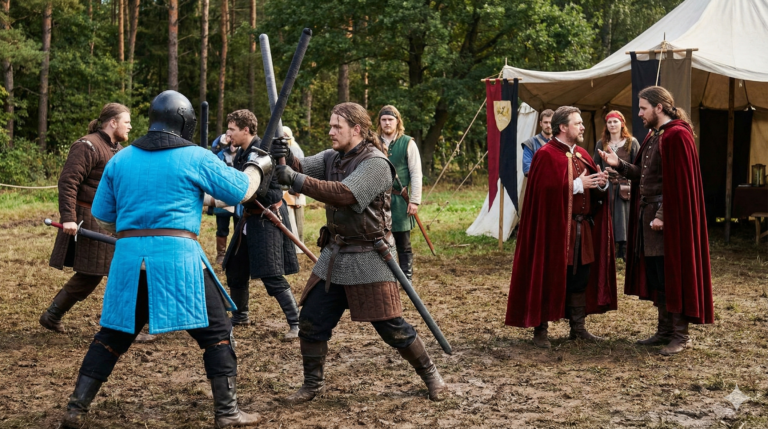
Live Action Role-Playing (LARP) or Live Role-Playing (LRP) describes a form of interactive game where participants physically portray characters in a fictional setting. The Merriam-Webster dictionary defines LARP as “a live-action role-playing game in which a group of people enacts a fictional scenario in real time typically under the guidance of a facilitator or organizer.” Unlike tabletop role-playing games where character actions are described verbally, LARP participants physically act out their characters’ movements and speech, creating an immersive theatrical experience.
LARPer / LARPing
A LARPer is a person who participates in live action role-playing. LARPing refers to the act of engaging in LARP activities. These terms function as both nouns and verbs in common usage within the community.
IC / In-Character
In-Character (IC) refers to behavior, dialogue, or actions that come from the perspective of the character being portrayed. When a player is IC, they are speaking, acting, and making decisions as their character would, rather than as themselves. Maintaining IC consistency is fundamental to creating immersive LARP experiences.
OOC / Out-of-Character
Out-of-Character (OOC) describes moments when a player breaks character to engage in real-world conversation or discuss gameplay mechanics. OOC interactions are typically signaled through specific gestures or verbal cues, such as raising a hand, crossing arms in an “X” pattern, or using designated safe words. Different LARP communities have developed various conventions for marking OOC moments to minimize disruption to the game’s atmosphere.
PC (Player Character)
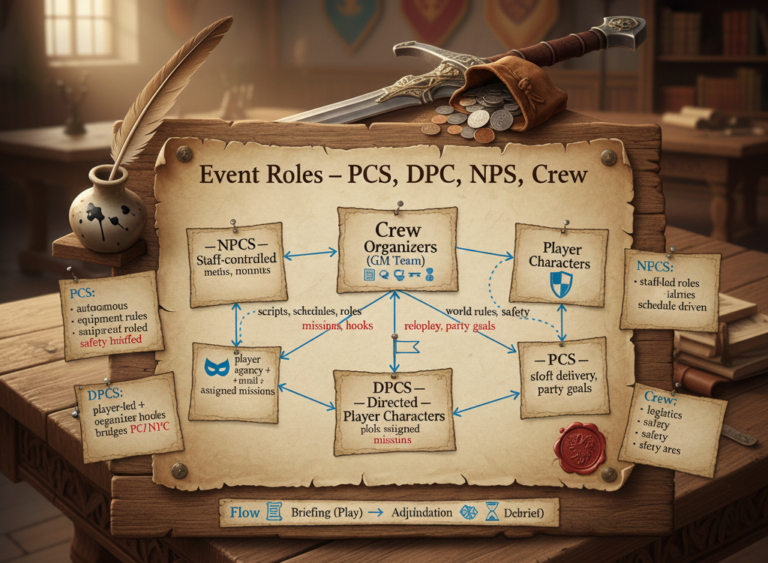
A Player Character (PC) is a character controlled by a participant in the LARP. PCs are the protagonists of the story, with their actions and decisions driving the narrative forward. Players typically create their own PC’s backstory, personality, and goals within the framework established by the game organizers.
NPC (Non-Player Character)
A Non-Player Character (NPC) is a character controlled by the game organizers, staff, or volunteer crew members rather than regular players. NPCs populate the game world, providing quest-givers, merchants, monsters, villains, and other roles necessary to the story. Unlike in tabletop RPGs where a single game master portrays all NPCs, in LARP each NPC is typically played by a separate crew member (Cambridge Larp Society Glossary).
DPC (Directed Player Character)
A Directed Player Character (DPC) is a player character who has been given specific aims or missions by the game organizers while remaining free to roleplay as they choose otherwise. DPCs bridge the gap between fully autonomous PCs and staff-controlled NPCs, allowing organizers to seed plot elements while preserving player agency.
Game Format and Style Terms
Campaign LARP
A campaign LARP runs over the course of multiple separate sessions, like episodes of a television series (Fair Escape: LARP Terminology). Players typically portray the same characters across events, developing long-term storylines and character progression. Campaign LARPs may include advancement systems where characters gain experience points, new abilities, or increased power over time.
One-Shot LARP
A one-shot LARP is contained within a single continuous event. It starts, runs for a designated period, then ends without continuing at future events. One-shots allow designers to create tightly focused narratives where all the dramatic events happen during the game, and players can take greater risks with their characters since there are no long-term consequences to preserve.
Fest LARP / Festival LARP
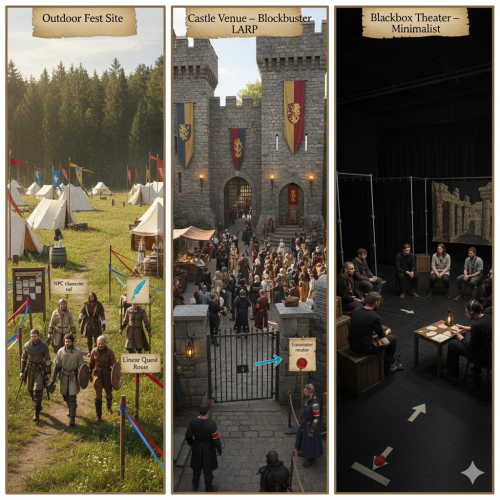
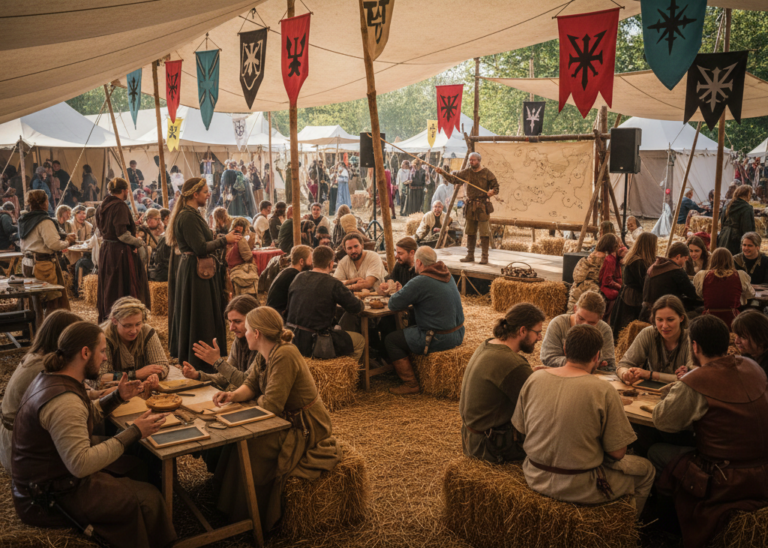
A fest LARP or festival LARP is a large-scale event with potentially several thousand players. These sprawling weekend-long games feature traders, food vendors, camping, and dozens of in-character encampments, sometimes including massive battles. Major fest LARPs in the UK include Lorien Trust and Curious Pasttimes, while Empire by Profound Decisions represents a more recent evolution of the format (LARPorLOL Glossary).
Blockbuster LARP
A blockbuster LARP is characterized by high production values, spectacular locations, international reach, and often mainstream media attention. These events frequently draw from established fandoms and provide costumes to participants. The term originated with games like The Monitor Celestra and College of Wizardry (Nordic Larp Wiki: Blockbuster). Blockbusters typically feature high ticket costs and combine brute-force design with 360-degree immersion.
Boffer LARP
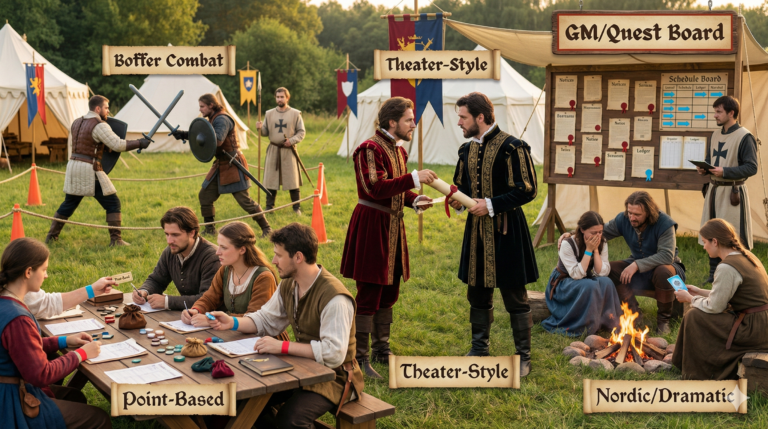
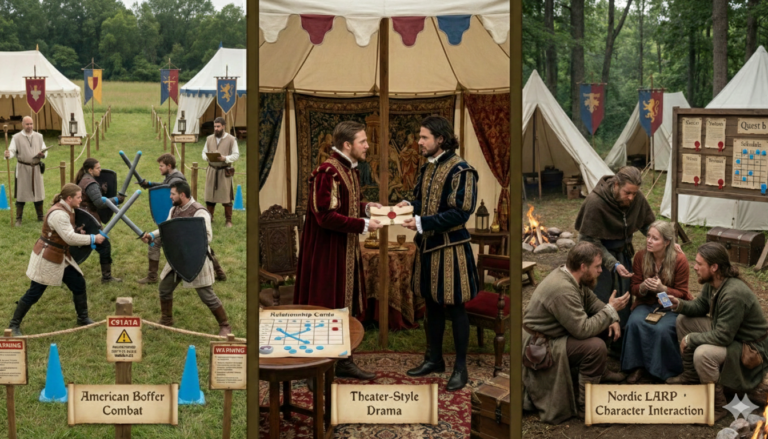
Boffer LARP refers to live action games featuring physical combat using padded foam weapons. This style has become synonymous with “American-style LARP” and emphasizes athletic, contact-based gameplay (The Geek Initiative: What Is Larp?). Most boffer LARPs require costuming and take place at dedicated sites to simulate the fictional location. Combat intensity and role-play ratios vary significantly between different boffer communities.
Theater-Style / Parlor LARP
Theater-style LARP (also called parlor LARP or chamber LARP) is designed to be played in a single room over a few hours with minimal props or combat. These games focus on characters, secrets, and social interaction rather than physical action. The term emerged in the 1990s to distinguish non-combat games from “adventure-style” LARPs, emphasizing that these games have more in common with improvisational theater without an audience (1000d4: Why is it called Theater LARP?).
Nordic LARP
Nordic LARP refers to shared traditions in Norway, Sweden, Denmark, and Finland characterized by strong emphasis on collaboration, collective storytelling, and artistic exploration. Story, drama, and atmosphere are held in high regard, with rules kept minimal and designed to break immersion as little as possible. Characters are described through personality traits and background rather than statistics, and score or experience points are rare. The tradition values LARP as a valid form of artistic expression that can be deeply meaningful to participants (Nordic Larp: What is Nordic Larp?).
Freeform
Freeform describes rules-light, story-oriented role-playing scenarios that blend elements of LARP and tabletop gaming. American freeform, as described by larpwright Lizzie Stark, is known for incorporating “meta-techniques”—mechanics that interrupt the narrative, heighten drama, or provide insight that remains hidden from characters (Analog Game Studies: Manipulating Environments in American Freeform). The term’s meaning varies by region; in some communities it refers to minimal-rules LARP, while in others it describes a specific design tradition.
Blackbox LARP
A blackbox LARP takes place in a minimalist space—typically a black room where lighting and sound can be carefully controlled to create atmosphere. The blackbox format allows for abstract storytelling techniques and focuses on emotional intensity over physical simulation. These games often feature short run times and experimental narrative structures (Nordic Larp: Blackbox Archives).
Linear
A linear is a small, contained LARP “quest” where a group of characters follows a set route through encounters with a specific objective. These may run as standalone events or as side adventures during larger fest LARPs. An NPC “character ref” typically accompanies the group to ensure they stay on course. Players who participate in linears are generally expected to reciprocate by playing monster roles for other groups.
Equipment and Props Terminology
Phys-Rep / Physical Representation
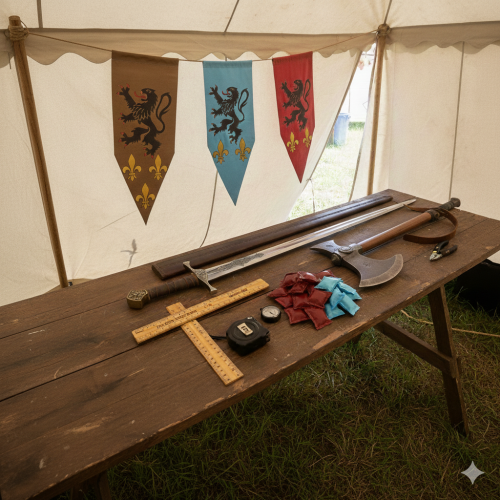
A phys-rep (physical representation) is any real-world object used to represent something in the game world. This includes weapons, props, costume pieces, and environmental elements. The term functions as both noun (“I need a phys-rep for this magic item”) and verb (“I’ll phys-rep the treasure chest”). A broken phys-rep is one that no longer serves its intended purpose safely—such as a sword where the handle separates from the blade—and must be repaired before use (Cambridge Larp Society Glossary).
Boffer Weapon
A boffer weapon is a padded foam weapon constructed for safe use in LARP combat. Traditional boffers use PVC or fiberglass cores wrapped with closed-cell foam and secured with tape. Construction methods include latex weapons (foam coated in liquid latex for a realistic appearance), foam-pad weapons (pipe insulation foam wrapped around cores), and modern alternatives using EVA foam and proprietary coatings like Plastidip (RPG.net: Props, Costuming and Phys-Reps).
Latex Weapon
Latex weapons are constructed with molded foam and latex rubber coating, producing highly realistic appearances. These weapons are typically lighter than other construction methods but are often designed for touch-contact rules rather than full-force combat. Major manufacturers include Calimacil, Epic Armoury, and Nemesis Workshops. Modern “latex” weapons often use polyurethane foam rather than actual latex for improved durability and allergen concerns.
LARP-Safe
The designation LARP-safe indicates a weapon or prop has been constructed specifically for live action role-playing and meets safety requirements for contact use. Safety standards vary between games—what is acceptable in one LARP may be prohibited in another. Items should always be inspected by designated safety marshals or weapons checkers before use at any event.
Packet
A packet is a small thrown object used to represent magical spells, thrown potions, or other ranged effects. Packets are typically constructed from bird seed wrapped in fabric secured with a rubber band or sewn closed (Citadel LARP: Prop Guide). When a packet strikes a valid target, the effect described by the thrower (such as “5 damage” or “Sleep”) is applied to that character.
Garb
Garb refers to LARP costuming—period-appropriate or genre-appropriate clothing worn during play. Most games have specified dress codes prohibiting modern items like logo t-shirts and blue jeans. The quality and authenticity of garb varies widely, from simple tunics to elaborate handcrafted costumes. Some blockbuster LARPs provide basic garb to ensure visual consistency.
Kit
A player’s kit encompasses all their LARP gear—costume, weapons, props, camping equipment, and accessories. Building a complete kit is often an ongoing project for LARP participants, with players gradually upgrading and expanding their equipment over time.
Clank
Clank is informal slang for a large amount of armor, or occasionally a person wearing heavy armor. The term derives from the distinctive sound made by metal armor components striking together during movement.
Gameplay and Mechanics Terms
GM / Gamemaster / Ref
A Gamemaster (GM) or Referee (Ref) determines the rules and setting of a LARP and facilitates play. Unlike tabletop GMs who have an overview of all action, LARP GMs seldom see everything happening during play since numerous participants interact simultaneously. Their role focuses more on arranging structure before play begins and managing the game during runtime. In British LARPs, the term “ref” is more common (LARPorLOL Glossary).
GOD (Games Operation Desk)
GOD (Games Operation Desk) is the central administrative hub at a LARP event where organizers and referees can be found managing the game. This is typically where players go to resolve rules questions, report incidents, register for adventures, or handle out-of-game administrative matters.
Crew / Crewing / Monstering
Crew members are participants who help run the LARP by playing NPCs, setting up encounters, managing props, and supporting the game environment. Crewing or monstering refers to attending an event as crew rather than as a player. Crew typically receive more information about the setting and plot than players do. Many LARPs expect players to contribute crew time in addition to playing.
Call / Skill Call
A call or skill call is a verbal declaration made during combat or roleplay to indicate a special effect. Common calls include damage numbers (“3 damage”), status effects (“Sleep,” “Stun,” “Fear”), and defensive abilities (“Resist,” “Dodge”). The Accelerant system popularized standardized calls that have been adopted across many North American LARPs (Madrigal LARP: The Accelerant System).
Time-In / Time-Out
Time-In marks when the game officially begins and players should be in character. Time-Out signals that play has paused or ended. A Time Freeze (or “Freeze”) halts all play temporarily—often for safety reasons or to allow NPCs to reset—and players are expected to stop moving and close their eyes.
PvP / PvE
PvP (Player versus Player) describes conflict between player characters, ranging from social manipulation to physical combat. PvE (Player versus Environment) describes challenges posed by NPCs, monsters, puzzles, and obstacles controlled by the game organizers. Different LARPs emphasize these modes differently—some focus heavily on PvP politics while others are primarily cooperative PvE adventures.
Soft Skills / Hard Skills
Soft skills are in-game character abilities represented through abstract mechanics rather than player physical capability. For example, if combat is resolved through rock-paper-scissors, fighting is a soft skill. Hard skills require the player to actually perform the action—picking a real lock or swinging a real (foam) weapon. Nordic LARPs typically use more soft skills, while boffer LARPs emphasize hard skills (Fair Escape: LARP Terminology).
Machine-Gunning / Drumrolling
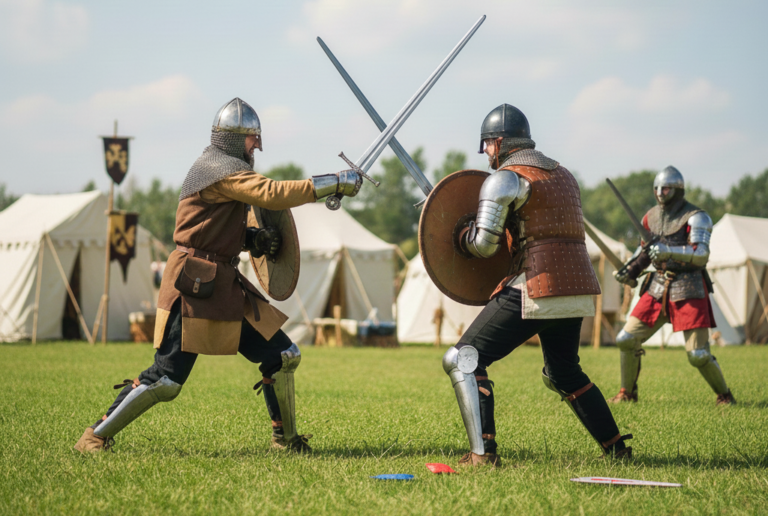
Machine-gunning or drumrolling refers to the prohibited practice of swinging a foam weapon unrealistically fast in combat. Since LARP weapons are meant to simulate heavy steel weapons, rapid flailing attacks undermine both safety and immersion. Most games require players to “pull” their blows—inhibiting the swing before impact to lose force at contact.
Munchkin
Munchkin is a pejorative term for someone more interested in personal power and “winning” than in collaborative roleplay. The word originates from descriptions of competitive 12-year-old D&D players. Munchkin behavior includes vastly optimizing character sheets to create unrealistic characters and using meta-game knowledge inappropriately. LARP, like all roleplaying games, should not be played purely to win at others’ expense.
Meta-Gaming
Meta-gaming is the act of using out-of-game knowledge to influence in-character actions in an unsporting manner. For example, an ignorant warrior character would not know the finer points of magic, but the player might use that real-world knowledge to solve a puzzle the character couldn’t. Most LARP communities consider meta-gaming poor sportsmanship.
CP (Character Points)
Character Points (CP) are earned through attending events and performing various services to a LARP community. CP is spent to purchase new in-game abilities and raise character statistics. This term is particularly common in Accelerant-system LARPs and similar campaign games with character advancement mechanics.
Downtime
Downtime refers to the period between LARP events when characters are assumed to continue their lives off-screen. Many campaign LARPs have formal downtime systems allowing players to submit actions their characters take between events—such as crafting, research, or travel—with results determined by organizers before the next session.
Safety and Consent Terminology
Cut / Brake / Kutt
Cut (or Brake in some systems, Kutt in Norwegian) is a universal stop word that immediately halts all play. When anyone calls “Cut,” all action freezes until the situation is resolved. This mechanic is inviolable—players must stop regardless of what is happening in-game. Cut is called for real injuries, safety concerns, consent violations, or any situation requiring immediate attention (Participation Safety).
Bleed
Bleed refers to the emotional, psychological, and physical states that transfer between player and character. Bleed-in occurs when the player’s emotions affect their character’s actions; bleed-out occurs when character experiences impact the player after the game ends. First introduced by Emily Care Boss in 2007, bleed is one of the most discussed aspects of larping alongside immersion (Nordic Larp: Bleed: The Spillover Between Player and Character). Bleed is not inherently negative—it can produce powerful cathartic experiences—but requires awareness and management.
Alibi
Alibi is the conceptual boundary maintaining that in-game actions represent the character, not the player. A strong alibi allows players to explore difficult themes while maintaining psychological distance. The alibi is a “polite fiction” that permits experimentation within the protected space of the game. Players may consciously strengthen or weaken their alibi depending on the experience they seek (Analog Game Studies: Alibi).
Steering
Steering describes a player’s conscious choice to alter the course of their character’s actions. Unlike bleed, which occurs unconsciously, steering is an intentional decision—perhaps choosing to make a character decision that creates more interesting drama even if the character might logically act differently. Players may steer toward or away from bleed, toward collaboration with other players, or toward narrative satisfaction.
OK Check-In
The OK Check-In is a safety mechanic allowing players to communicate about wellbeing without pausing play. One player makes the “OK” hand sign (thumb and forefinger forming a circle); the other responds with thumbs-up (doing fine), thumbs-down (not okay), or a wavy flat hand (uncertain). Non-thumbs-up responses prompt the checking player to offer assistance (Nordic Larp: Creating a Culture of Trust through Safety and Calibration Larp Mechanics).
Lookdown / See No Evil
The Lookdown is a technique for gracefully exiting a scene without explanation. A player covers their eyes or looks down, then walks away; other players ignore the exit and continue play. This allows someone to remove themselves from an uncomfortable situation without breaking immersion for others or requiring justification.
Tap-Out
The Tap-Out is borrowed from wrestling—a player taps their scene partner twice to signal they’ve reached a limit and need to de-escalate. This allows communication about boundaries without verbal interruption of the scene.
Calibration
Calibration encompasses the explicit and implicit ways players negotiate play style, intensity, and genre during a LARP. Good calibration mechanics allow players to adjust their experience in real-time without disrupting the game for others. The term gained currency in Nordic LARP theory discussions around 2016 (Participation Safety: Calibration Mechanics).
Debrief
A debrief is a formal space after the game for players to express feelings and share experiences. Debriefing helps process intense emotions, contextualize bleed, and transition back to everyday life. Effective debriefs create opportunities for both celebration and support, allowing players to discuss what happened without judgment.
De-Roleing
De-roleing is the practice of consciously and methodically setting aside one’s character at the end of a game. This might involve removing costume elements mindfully, performing a brief ritual, or verbally stating “I am [player name], not [character name].” De-roleing helps establish psychological distance from the character and reduces unwanted bleed.
Sanctuary Space
A Sanctuary Space is a designated off-game area where players can go to decompress, step out of character, or receive support. These spaces are typically comfortable, well-lit, and staffed by trained safety volunteers. Players in sanctuary spaces are not expected to be in character or engage with game content.
Lines and Veils
Lines are hard limits—content that will not appear in the game under any circumstances. Veils are content that may exist in the game world but will not be portrayed explicitly; the scene “fades to black.” These concepts, originating from tabletop RPG safety discussions, have been widely adopted in LARP design to establish content boundaries before play begins.
Community and Organization Terms
Knutepunkt / Solmukohta
Knutepunkt is an annual Nordic role-playing conference running since 1997 in Norway, cycling through Nordic countries (Knutpunkt in Sweden, Knudepunkt in Denmark, Solmukohta in Finland). The conference has been vital in establishing Nordic larp identity and features panel debates, workshops, short larps, and academic discussions. Since 2001, accompanying books on larp theory have been published for most conferences (Wikipedia: Knutepunkt).
Workshop
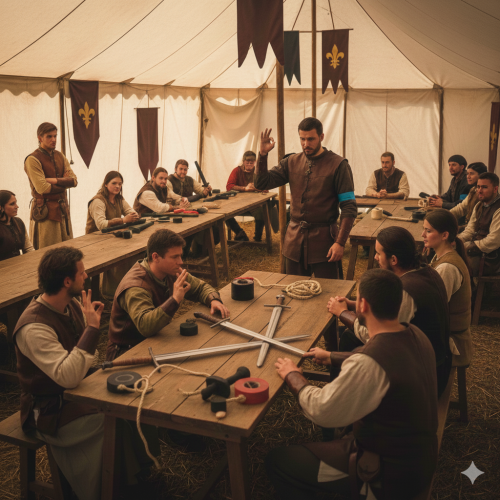
A workshop in LARP context is a pre-game session teaching players necessary skills, establishing relationships between characters, practicing safety mechanics, and building the collaborative culture needed for play. Workshops may include exercises for physical warm-up, emotional preparation, consent negotiation, and scene practice.
360-Degree Illusion / 360
The 360-degree illusion (or simply “360”) describes an approach where the game environment is completely dressed to match the fictional setting from every angle. Players should be able to look in any direction without seeing anachronistic or immersion-breaking elements. This design philosophy is particularly associated with blockbuster LARPs and high-production Nordic games.
Larpwright
A larpwright is someone who designs and writes LARP scenarios—analogous to a playwright for theater. The term, originating in Swedish LARP community, reflects the creative authorship involved in creating structured play experiences. Larpwrights may produce everything from short blackbox games to elaborate multi-year campaigns.
Herd Competence
Herd competence describes when enough players in a game understand and model desired play culture that newcomers naturally absorb appropriate behavior. A game with strong herd competence can integrate new players smoothly because experienced players demonstrate proper techniques, safety mechanics, and collaborative attitudes.
Play to Lose
Play to lose is a design philosophy encouraging players to make choices that create interesting story outcomes rather than optimal tactical results. Instead of fighting to survive at all costs, players embrace dramatic failures, character setbacks, and noble sacrifices that generate compelling narrative moments.
Play to Lift
Play to lift means actively supporting other players’ stories and making them look good. Rather than competing for spotlight, players practicing this philosophy create opportunities for others to shine, respond enthusiastically to others’ creative contributions, and build shared narrative success.
Ars Amandi
Ars Amandi (Latin: “the art of loving”) is a technique for simulating physical intimacy through non-intimate touch. Players caress each other’s hands and arms while maintaining eye contact, allowing emotional connection and romantic scenes without actual intimate contact. This technique is widely used in Nordic LARP and has been adopted internationally.
Rule Systems and Design Terms
Accelerant
The Accelerant system is a live action rules framework designed for rich skill sets without overly complicated mechanics. It uses standardized verbal calls, allows for hidden abilities, and emphasizes player action over abstracted resolution. Originally known as the nTeraction system, Accelerant has become the basis for numerous North American campaign LARPs including Madrigal, Numina, and many others (Madrigal LARP: The Accelerant System).
Diegetic / Non-Diegetic
Diegetic elements exist within the game world—characters can perceive and interact with them. Non-diegetic elements exist only at the player level, such as rules explanations or safety calls. A “diegetic” LARP minimizes non-diegetic interruptions; what you see is what you get. Understanding this distinction helps players navigate when information is in-character versus out-of-character.
Meta-Technique
Meta-techniques are mechanics that communicate between players rather than between characters. Examples include inner monologues spoken aloud for other players to hear, or lighting changes that establish mood. Meta-techniques interrupt the internal logic of character consciousness but provide tools for collaborative storytelling and emotional calibration.
Magic Circle
The magic circle is the conceptual boundary separating the LARP experience from ordinary reality. Within the magic circle, different rules apply—foam swords cause damage, spoken incantations have power, and social hierarchies may be inverted. The magic circle is not impermeable; players constantly negotiate its boundaries.
Consent Mechanics
Consent mechanics are structured systems for negotiating content boundaries during play. These may include pre-game questionnaires, colored badges indicating comfort levels with various themes, or in-game techniques for establishing scene boundaries. Effective consent mechanics allow diverse players to share experiences while respecting individual limits.
Secrets and Powers
Secrets and Powers (S&P) describes a style of LARP characterized by characters beginning with secrets to protect or uncover, combined with special abilities governed by game mechanics. This style is particularly common in parlor/theater LARP traditions and creates games driven by information exchange and strategic ability use.

Sources and Further Reading
- Wikipedia. “Live action role-playing game.” https://en.wikipedia.org/wiki/Live_action_role-playing_game
- Nordic Larp. “What is Nordic Larp?” https://nordiclarp.org/what-is-nordic-larp/
- Merriam-Webster Dictionary. “LARP.” https://www.merriam-webster.com/dictionary/LARP
- Cambridge Larp Society. “Glossary.” https://www.camlarp.co.uk/Glossary
- Fair Escape. “LARP Terminology.” https://fairescape.wordpress.com/larp-terminology/
- LARPorLOL. “LARP Glossary.” http://larporlol.weebly.com/larp-glossary.html
- The Geek Initiative. “What Is Larp?” https://geekinitiative.com/tgilarps/what-is-larp-faq/
- Nordic Larp Wiki. “Blockbuster.” https://nordiclarp.org/wiki/Blockbuster
- 1000d4. “Why is it called Theater LARP?” http://www.1000d4.com/2016/04/30/why-is-it-called-theater-larp/
- Analog Game Studies. “Manipulating Environments in American Freeform.” https://analoggamestudies.org/2015/11/manipulating-environments-in-american-freeform/
- RPG.net. “LARP: Live Action & Real Problems #5: Props, Costuming and Phys-Reps.” https://www.rpg.net/columns/larping/larping5.phtml
- Citadel LARP. “Boffer Weapon, Armor, Shields, and Prop Guide.” https://citadel-larp.com/props-and-gear-guidelines
- Madrigal LARP. “The Accelerant System.” https://madrigallarp.wordpress.com/rules-system/the-accelerant-system/
- Participation Safety. “Calibration Mechanics.” https://participationsafety.wordpress.com/category/calibration-mechanics/
- Bowman, Sarah Lynne. “Bleed: The Spillover Between Player and Character.” Nordic Larp, 2015. https://nordiclarp.org/2015/03/02/bleed-the-spillover-between-player-and-character/
- Brown, Maury. “Creating a Culture of Trust through Safety and Calibration Larp Mechanics.” Nordic Larp, 2016. https://nordiclarp.org/2016/09/09/creating-culture-trust-safety-calibration-larp-mechanics/
- Analog Game Studies. “Alibi.” https://analoggamestudies.org/tag/alibi/
- Wikipedia. “Knutepunkt.” https://en.wikipedia.org/wiki/Knutepunkt
- Nordic Larp Wiki. “Knutepunkt.” https://nordiclarp.org/wiki/Knutepunkt
- TechTarget. “What is LARP (Live-Action Role-Playing)?” https://www.techtarget.com/whatis/definition/LARP