
Combat Terms: The Complete Medieval Warfare Vocabulary
Home » Glossary » Terminology Hub » Combat Terms: The Complete Medieval Warfare Vocabulary
Combat Terms: The Complete Medieval Warfare Vocabulary
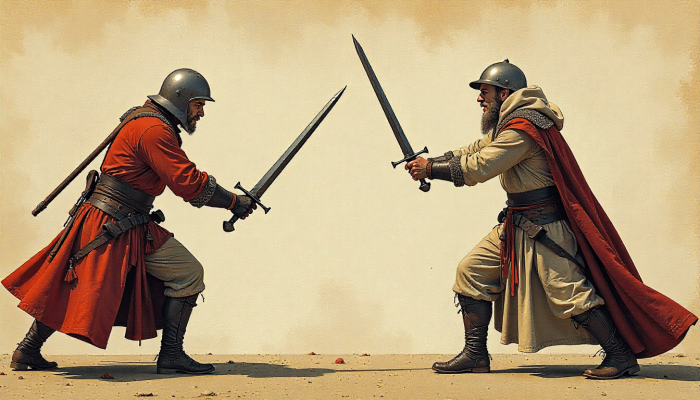
The Language of Medieval Warfare
Medieval combat encompassed a sophisticated vocabulary describing techniques, positions, and tactical concepts that evolved across centuries and cultures. From the Germanic sword traditions documented in fechtbücher (fight books) to the refined systems of Renaissance masters, combat terminology reveals the complexity and artistry of historical martial arts. Understanding these terms enriches appreciation for replica weapons and provides context for their historical use.
This comprehensive glossary draws from primary sources including the Royal Armouries manuscript collection, period fighting manuals, and archaeological evidence. Terms span multiple traditions—European longsword, sword and buckler, polearms, mounted combat, and Eastern martial systems that influenced medieval warfare through trade and crusade contacts.
Offensive Techniques and Attacks
Primary Cutting Attacks
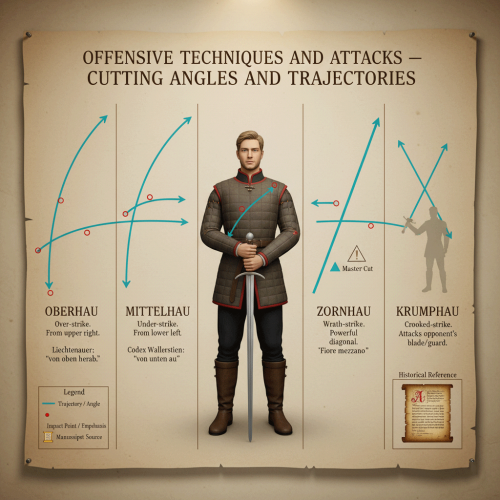
Oberhau (German: “over-strike”): A downward diagonal cut delivered from above, typically targeting the opponent’s head or shoulders. Master Johannes Liechtenauer’s verses, preserved in the Nuremberg Hausbuch, describe this as one of five master cuts.
Unterhau (German: “under-strike”): An upward diagonal cut originating from below, targeting the opponent’s arms, torso, or groin. According to the Codex Wallerstein, this cut effectively counters high guards.
Mittelhau (German: “middle-strike”): A horizontal cut delivered at torso height. The Italian master Fiore dei Liberi called the equivalent “mezzano” in his treatise Fior di Battaglia.
Zornhau (German: “wrath-strike”): A powerful diagonal cut from the right shoulder, considered a master technique in the German tradition. Named for its aggressive nature and psychological impact.
Krumphau (German: “crooked-strike”): A deceptive cut that breaks the opponent’s guard by striking across their blade at an angle. Essential for defeating the ox guard (ochs).
Zwerchhau (German: “cross-strike”): A horizontal cut delivered with crossed arms, striking with the short edge while simultaneously defending. The Peter von Danzig fechtbuch details its use against all guards.
Schielhau (German: “squinting-strike”): A deceptive cut where the swordsman appears to aim at one target while striking another. Named for the squinting appearance of the eyes when executing this technique.
Fendente (Italian: “cleaving blow”): A powerful vertical downward cut aimed at splitting the opponent from crown to groin. Described extensively in Achille Marozzo’s Opera Nova.
Montante (Italian: “ascending blow”): An upward vertical cut, the opposite of fendente. Spanish masters called this “tajo vertical ascendente.”
Mandritto (Italian: “right-hand blow”): Any cut delivered from the swordsman’s right side, regardless of angle. The corresponding left-side cuts are called “riverso.”
Thrusting Techniques
Stoccata (Italian: “thrust”): A general term for any thrusting attack, refined into numerous variations by Renaissance masters. The Academia Nazionale di Scherma identifies over thirty distinct thrust types in historical treatises.
Imbrocatta (Italian: “downward thrust”): A descending thrust delivered over the opponent’s weapon, typically targeting the face or upper chest.
Punta riversa (Italian: “reverse thrust”): A thrust delivered with the back edge leading, often used in combination with circular blade movements.
Longpoint Thrust: An extended thrust where the swordsman steps deeply forward, maximizing reach. George Silver’s Paradoxes of Defence criticizes this as dangerously overextended.
Estocada (Spanish: “thrust”): The Spanish school’s general thrust, emphasizing geometric precision and mathematical angles as described in Jerónimo Sánchez de Carranza’s De la Filosofía de las Armas.

Specialized Offensive Actions
Mordschlag (German: “murder-strike”): Gripping the blade and striking with the pommel or crossguard like a hammer. Particularly effective against armored opponents, as documented in Hans Talhoffer’s Fechtbuch.
Mordhau (German: “murder-stroke”): Half-swording technique where the blade is gripped to use the crossguard as a pick against armor gaps.
Pommel Strike: Close-range technique immortalized in the manuscript phrase “end him rightly” by unscrewing and throwing the pommel. The Gladiatoria group manuscripts detail practical pommel strikes in grappling range.
Durchlaufen (German: “running through”): Closing distance by ducking under the opponent’s weapon to enter grappling range. Essential for armored combat where wrestling determined many encounters.
Mutieren (German: “mutating”): Transforming a thrust into a cut or vice versa mid-action based on opponent’s response. Requires exceptional blade control and timing.
Defensive Techniques and Parries
Fundamental Defensive Actions
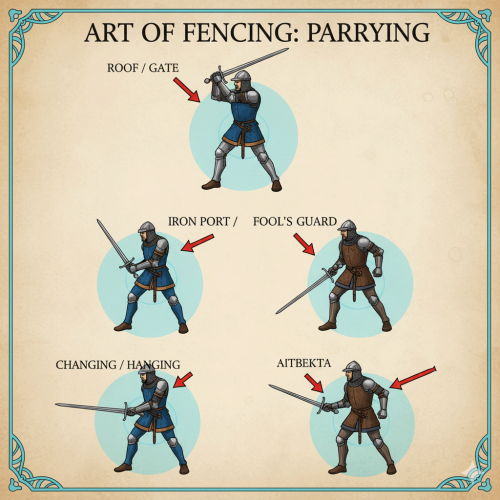
Parry: Deflecting an attack using the blade or other defensive implement. Medieval systems distinguished between:
- True Cross Parry: Intercepting the attack perpendicular to its line
- Hanging Parry: Angling the blade to deflect while maintaining offensive potential
- Beat Parry: Forcefully striking the attacking blade aside
Absetzen (German: “setting aside”): Simultaneously deflecting an attack while counter-thrusting, a hallmark of efficient German swordsmanship.
Versetzen (German: “displacing”): Blocking with the strong of the blade while positioning for immediate counter-attack. The Codex Döbringer emphasizes this as superior to static blocking.
Advanced Defensive Concepts
Meisterhau (German: “master cuts”): The five cuts that break all guards—zornhau, krumphau, zwerchhau, schielhau, and scheitelhau. Each serves defensive and offensive purposes simultaneously.
Überlaufen (German: “overrunning”): Defending against low attacks by striking over them to the opponent’s upper openings. Exploits the commitment required for low-line attacks.
Abnehmen (German: “taking off”): Removing the blade from bind to strike from another angle. Requires precise timing to avoid being struck during disengagement.
Cavazione (Italian: “disengagement”): Circular blade movement to avoid the opponent’s parry and strike the opening created. Fundamental to later rapier systems but present in medieval sword combat.
Inquartata (Italian: “quartering step”): Defensive footwork moving offline while maintaining blade presence. Salvator Fabris’s De lo Schermo elaborates this into a complete defensive system.
Guards and Fighting Positions
German Guard Positions
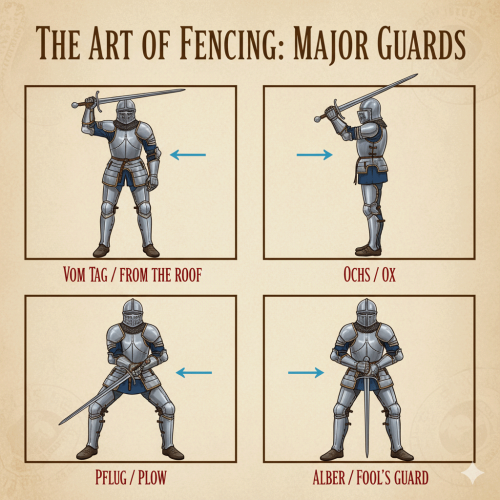
Ochs (German: “ox”): High guard with point threatening opponent’s face, blade angled up and forward. Named for the horn-like appearance of the sword position.
Pflug (German: “plow”): Middle guard with point forward at chest height, resembling a plow’s position. Offers excellent defensive coverage while maintaining offensive threat.
Alber (German: “fool”): Low guard with point toward ground, appearing vulnerable but prepared for powerful upward cuts. The Glasgow Fechtbuch warns against underestimating this deceptively open position.
Vom Tag (German: “from the roof”): High guard with sword held above head or shoulder, prepared for powerful downward cuts. Multiple variations exist based on blade angle and hand position.
Nebenhut (German: “side guard”): Sword held at the side with point back, prepared for upward or horizontal cuts. Conceals blade length and attacking intentions.
Schrankhut (German: “barrier guard”): Crossed-arm position that protects while threatening with false edge cuts. Also called the “crossed guard” in English sources.
Langort (German: “long point”): Extended thrust position that maximizes reach while controlling centerline. Fundamental to understanding distance and timing.
Italian Guard System
Posta di Donna (Italian: “lady’s guard”): High guard similar to vom tag, named perhaps for its elegant appearance. Fiore dei Liberi describes both right and left variations.
Posta Frontale (Italian: “frontal guard”): Forward-facing middle guard providing balanced offense and defense. The Flos Duellatorum manuscripts show numerous applications.
Porta di Ferro (Italian: “iron gate”): Low guard protecting the lower body while preparing upward attacks. Named for its defensive strength.
Posta di Finestra (Italian: “window guard”): High guard framing the face like a window, excellent for thrusting and deflection.
Dente di Zenghiaro (Italian: “boar’s tooth”): Low-middle guard with blade angled up aggressively like a boar’s tusk. Combines defensive stability with offensive readiness.
Spanish and Other Traditions
Destreza Guards: The Spanish school emphasized mathematical precision with guards based on geometric principles. Gérard Thibault’s Académie de l’Espée illustrates these complex angular relationships.
Ward System: English masters like George Silver described wards including:
- True Guardant Ward: Balanced middle position
- Open Ward: Deliberately exposed position inviting specific attacks
- Close Ward: Defensive position with blade across body
- Variable Ward: Fluid position adaptable to opponent’s actions
Binding and Blade Contact
The Art of the Bind
Binden (German: “binding”): When blades make contact and maintain pressure. The Hs.3227a manuscript describes binding as the foundation of feeling (fühlen) and subsequent techniques.
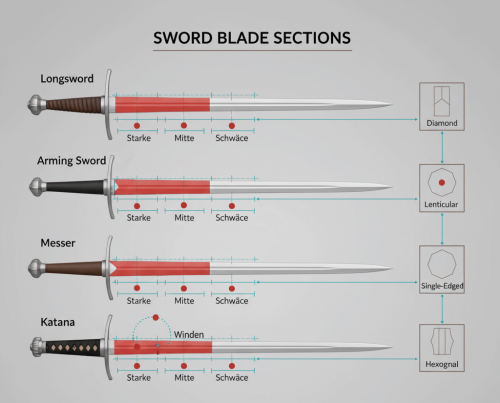
Starke (German: “strong”): The forte or strong third of the blade nearest the hilt, optimal for binding and controlling opponent’s weapon.
Schwäche (German: “weak”): The foible or weak third nearest the point, vulnerable in the bind but essential for deceptive actions.
Winden (German: “winding”): Rotating the blade while maintaining contact to gain mechanical advantage or create openings. Central to German longsword methodology.
Pressure and Blade Manipulation
Duplieren (German: “doubling”): Striking behind the opponent’s blade using the short edge while in bind. Exploits overcommitment to strong pressure.
Nachreisen (German: “traveling after”): Following the opponent’s blade as they withdraw from bind to maintain initiative. Prevents clean disengagement and reset.
Fühlen (German: “feeling”): Sensing the opponent’s pressure and intention through blade contact. Master Sigmund Ringeck emphasized this as essential for choosing correct techniques.
Sprechfenster (German: “speaking window”): The bind position where blades cross near the hilts, called “speaking” because it communicates the opponent’s intentions.
Distance and Timing Concepts
Measure and Range
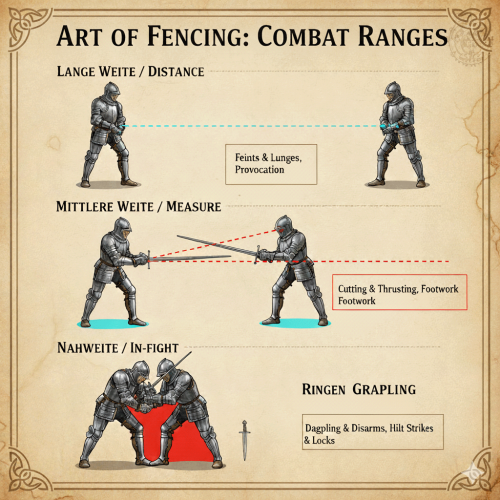
Misura (Italian: “measure”): The critical distance concept determining which techniques are viable:
- Misura Larga: Wide measure where only longest attacks can reach
- Misura Stretta: Close measure where most techniques are viable
- Fuori Misura: Out of measure, beyond striking distance
Maai (Japanese: “interval”): Similar distance concept from Japanese martial arts that influenced European understanding through cultural exchange. The Koryū Research Institute documents parallel development of distance concepts.
Vor (German: “before”): The initiative or offensive advantage. Who acts first controls the engagement’s tempo.
Nach (German: “after”): The defensive position of responding to opponent’s actions. Skilled fighters transform nach into vor through superior technique.
Indes (German: “meanwhile”): The critical moment during an action where decisions determine success. Neither purely vor nor nach but the instant of potential.
Tempo and Rhythm
Tempo: A unit of fencing time equaling one simple action. Italian masters divided combat into:
- Primo Tempo: First intention attacks
- Mezzo Tempo: Half-tempo actions executed during opponent’s preparation
- Contratempo: Counter-time actions that interrupt opponent’s attack
Cadence: The rhythm of alternating attacks and defenses. Breaking cadence disrupts opponent’s timing and creates openings.
Precipitate: Rushing timing to strike before opponent completes their action. Requires precise judgment of distance and commitment.
Footwork and Movement
Basic Stepping Patterns
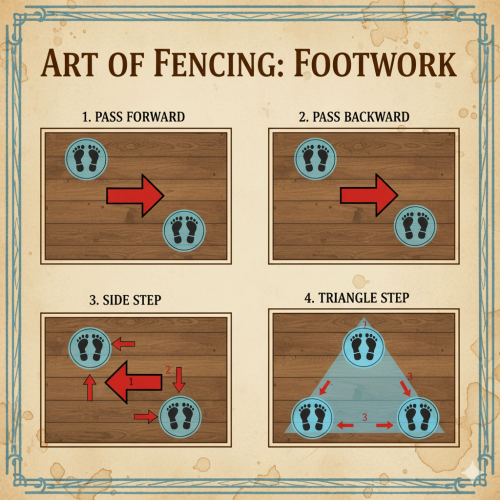
Passing Step: Moving the rear foot past the front foot, changing lead. Covers maximum distance but commits to the action.
Gathering Step: Bringing the rear foot to the front foot’s position while the front advances. Maintains stance integrity while advancing.
Triangle Step: Moving offline at angles to create superior position. The Academy of European Medieval Martial Arts emphasizes this for longsword combat.
Volte: Circular stepping that moves the body offline while maintaining blade presence. Italian rapier systems developed this to high art.
Inquartata: Quarter turn of the body while stepping, removing the target line while counter-attacking.
Advanced Movement Concepts
Girata (Italian: “turning”): Full body rotation while maintaining balance and blade control. Used for powerful cuts and position changes.
Traverse: Lateral movement maintaining facing and guard. Essential for controlling distance without telegraphing intentions.
Slope Step: Diagonal backward step that maintains measure while improving defensive angle. Described in English backsword sources.
Lunge Recovery: Methods for safely returning from extended attacks:
- Redoublement: Renewing attack without recovering
- Reprise: Full recovery before new attack
- Balestra: Jump-lunge combination for explosive distance coverage
Grappling and Close Combat
Wrestling at the Sword
Ringen am Schwert (German: “wrestling at the sword”): Grappling techniques while maintaining weapon control. The Codex Wallerstein dedicates entire sections to these techniques.
Durchlaufen (German: “running through”): Entering grappling range by moving under opponent’s weapon. Requires timing and courage.
Arm Break: Controlling opponent’s weapon arm to hyperextend the elbow. Multiple variations exist using pommel, guard, or free hand.
Weapon Seizure: Techniques for safely grasping opponent’s blade to control or disarm. Requires proper timing and hand protection.
Disarming Techniques
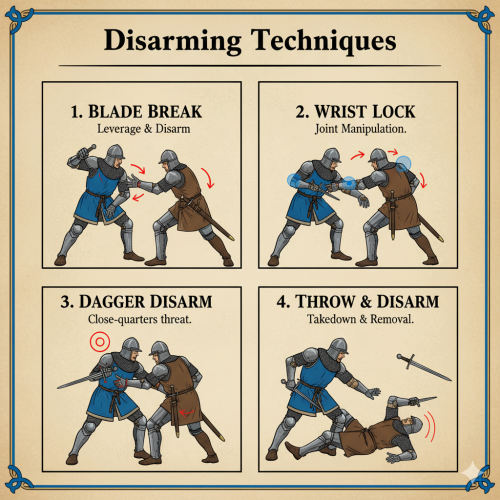
Entwaffnen (German: “disarming”): Systematic methods for removing opponent’s weapon:
- Leverage Disarms: Using mechanical advantage against grip
- Strike Disarms: Targeting hands or weak grip points
- Entanglement Disarms: Binding and twisting to break grip
Key Lock: Controlling opponent’s weapon hand through joint manipulation. Effective against single-handed weapons.
Strip and Strike: Pulling opponent’s weapon while simultaneously attacking. Requires superior strength or mechanical advantage.
Polearm and Staff Combat Terms
Halberd and Poleaxe Techniques
Queue Strike: Hitting with the butt end of the pole. Effective for close-range strikes and controlling distance.
Hook and Pull: Using the halberd’s hook or bill to trap limbs or weapons. The Paulus Hector Mair manuscripts detail numerous applications.
Thrust and Withdraw: Quick jabbing attacks that maintain distance advantage. Fundamental to all polearm systems.
Sweeping Cut: Wide arc attacks using the polearm’s reach advantage. Effective for controlling multiple opponents or creating space.
Choke Up: Shortening grip for close combat while maintaining control of the weapon’s length.
Quarterstaff Terminology
Half-Staff: Gripping the staff at its center for balanced offense and defense. George Silver considered this superior to end-grip methods.
Pool Cue Grip: One hand at end, one at middle, maximizing reach for thrusting. Named anachronistically but describes historical technique.
Molinello (Italian: “windmill”): Continuous circular motions creating defensive barrier and offensive opportunities. Applied to all staff weapons.
Cross Block: Using the staff horizontally to intercept attacks. Provides strong defense but limits immediate counter-attack options.
Mounted Combat Terminology
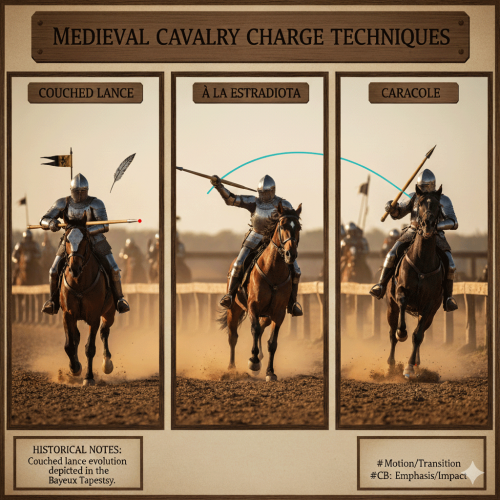
Cavalry Charge Techniques
Couched Lance: Tucking the lance under the arm for maximum impact. The Bayeux Tapestry depicts the evolution of this technique.
À la Estradiota: Light cavalry technique of throwing the lance before impact. Named after Balkan mercenaries who popularized it.
Caracole: Wheeling maneuver where cavalry fire or strike in succession. Allowed continuous pressure while individual riders recovered.
Mounted Swordplay
Moulinet: Circular sword cuts delivered from horseback. Protected the rider while threatening multiple angles.
Passing Cut: Striking while riding past the opponent. Required precise timing and excellent horsemanship.
Cross Body Strike: Attacking targets on the opposite side of the horse. Demonstrated rider’s skill and weapon control.
Eastern Influence Terms
Middle Eastern Techniques
Shibriya: Arabic term for feinting attacks that influenced Iberian fencing through Moorish contact.
Maul: Persian/Arabic term for tactical positioning that entered European vocabulary through crusade contact.
Asian Martial Concepts
Kiai: Spirited shout accompanying attacks, adopted by some European masters for psychological effect. The Richard Wagner Museum documents similar concepts in Germanic tradition.
Zanshin: Continued awareness after completing technique. While Japanese in origin, parallel concepts exist in European sources as “remaining vigilant.”
Specialized Combat Situations
Multiple Opponent Tactics
Rondel Fighting: Circular movement patterns when facing multiple opponents. Prevents encirclement while maintaining mobility.
Line of Attack: Positioning opponents in line to prevent simultaneous engagement. Fundamental principle for surviving outnumbered situations.
Selective Engagement: Choosing when and whom to attack when outnumbered. The Codex Guelf emphasizes mobility and psychology.
Armored Combat Adaptations
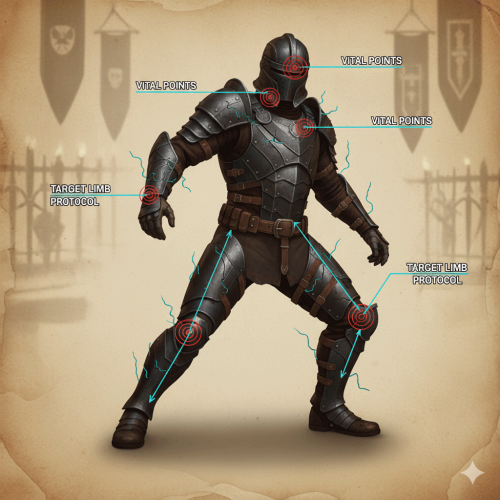
Half-Swording: Gripping the blade with the off-hand for precise thrusting against armor gaps. Essential technique for armored combat.
Thunderstroke: Powerful percussive blows aimed at stunning through armor. Effectiveness debated but psychologically significant.
Joint Attack: Targeting articulation points in armor where protection is weakest. Required precise knowledge of armor construction.
Psychological and Tactical Terms
Mental Combat Concepts
Terribilità: Italian concept of fearsome presence that defeats opponents psychologically. Cultivated through reputation and bearing.
Fehler (German: “error”): Deliberately showing openings to invite predictable attacks. Required confidence and superior timing.
Provocazione: Italian term for actions intended to trigger specific responses. Foundation of tactical manipulation.
Battlefield Awareness
Situational Dominance: Controlling engagement conditions through positioning and timing. Extends beyond individual technique to tactical mastery.
Combat Breathing: Controlled breathing to maintain stamina and composure. Period sources describe various methods though terminology varies.
Battle Fury: Controlled aggression that enhances performance without compromising judgment. Distinguished from berserk rage by maintained technical precision.
Training and Practice Terminology
Exercise Classifications
Assalto (Italian: “assault”): Training exercises progressing from set plays to free fencing. The Scuola Magistrale Militare di Scherma maintains traditional progression systems.
Flourish: Solo practice forms demonstrating technique and control. Served both training and demonstration purposes.
Set Play: Predetermined sequence of attacks and defenses for learning timing and distance. Called “plays” in English sources.
Equipment and Safety Terms
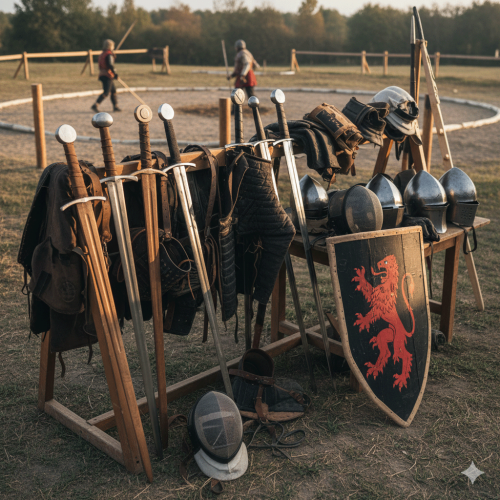
Federschwert: Training sword with flexible blade and flared tip. Allowed realistic practice with reduced injury risk.
Dussack: Practice weapon of leather or wood simulating military sabers. The German National Museum preserves numerous examples.
Gambeson: Padded jacket worn under armor or alone for training protection. Essential for weapon practice and light combat.
Competition and Dueling Terms
Formal Combat Structures
Pas d’Armes: Formal tournament where knights defended a position against challengers. Elaborate rules governed combat and honor.
Holmgang: Norse judicial duel with specific rules and boundaries. Influenced medieval trial by combat traditions.
Recti: German judicial combat positions described in legal codes. Specific stances required at duel commencement.
Victory Conditions
First Blood: Combat ending with first wound drawing blood. Common in honor duels where death wasn’t sought.
Yield: Verbal or physical surrender ending combat. Honorable defeat when continuation meant certain death.
Mortal Victory: Combat continuing until death or incapacitation. Reserved for serious crimes or irreconcilable disputes.
Regional Combat Traditions
Germanic School Characteristics
The Germanic tradition, documented extensively in the Nuremberg State Archives, emphasized efficiency and biomechanical optimization. Key principles included:
- Unity of offense and defense in single actions
- Exploitation of leverage and body mechanics
- Systematic approach to technique selection
Italian School Philosophy
Italian masters, particularly the Bolognese tradition preserved at the University of Bologna, focused on geometric precision and theoretical frameworks:
- Mathematical analysis of angles and distances
- Elaborate guard systems with specific applications
- Integration of multiple weapon types in single systems
English Martial Tradition
English sources like those in the British Library reveal distinct characteristics:
- Emphasis on practical effectiveness over elaborate technique
- Integration of wrestling with weapon combat
- Simplified teaching methods for common soldiers
Iberian Contributions
Spanish and Portuguese traditions, influenced by Moorish contact and preserved in the Biblioteca Nacional de España, contributed:
- Mathematical approach to swordsmanship (Destreza)
- Integration of civilian and military techniques
- Philosophical frameworks for understanding combat
Evolution and Historical Context
Technological Influences
Advances in metallurgy and armor design continuously influenced combat terminology and technique. The Deutsches Historisches Museum documents how terms evolved with technology:
- Techniques specific to mail armor became obsolete with plate armor
- Gunpowder weapons created new tactical vocabulary
- Civilian dueling divorced certain terms from battlefield context
Cultural Exchange
Trade, warfare, and diplomatic contact spread combat knowledge across cultures. The Silk Road Foundation documents martial knowledge exchange:
- Crusades introduced Eastern techniques to European vocabulary
- Mongol invasions brought Asian tactical concepts westward
- Renaissance humanism encouraged systematic documentation and standardization
Documentary Evidence
Our understanding of medieval combat terminology comes from diverse sources:
- Fechtbücher: Illustrated fighting manuals preserving technique and terminology
- Legal Codes: Judicial combat regulations defining formal combat terms
- Chronicles: Historical accounts using period combat vocabulary
- Archaeological Evidence: Weapon and armor finds confirming textual descriptions
The Living Language of Historical Combat
Medieval combat terminology represents more than historical curiosity—it’s a living language still used by practitioners of Historical European Martial Arts (HEMA), collectors, and scholars. Organizations like the HEMA Alliance maintain these traditions while adapting terminology for modern safety requirements.
Understanding combat terms enhances appreciation for medieval weapons as functional tools rather than mere decorative objects. Each term encodes centuries of martial wisdom, representing solutions to life-and-death problems faced by historical warriors. Whether examining a replica sword’s balance point or discussing historical techniques, this vocabulary connects modern enthusiasts with medieval martial traditions.
The terminology continues evolving as researchers discover new manuscripts, archaeologists unearth artifacts, and practitioners test interpretations through physical practice. Modern technology, including motion capture and biomechanical analysis conducted by institutions like the University of Leeds International Medieval Congress, provides new insights into historical techniques while respecting traditional terminology.
For collectors, this vocabulary provides essential context for understanding replica weapons’ historical purpose and evaluating their functional authenticity. A sword’s design makes more sense when one understands the techniques it was meant to perform. Guard positions explain hilt configurations. Combat ranges clarify blade lengths. Binding actions reveal the importance of blade geometry.
Reference Resources and Further Study
Primary Source Collections
- Wiktenauer: Comprehensive database of historical fighting manuals
- Royal Armouries Manuscript Collection: Digital access to period combat treatises
- Bibliothèque Nationale de France: Extensive medieval manuscript collection
- Metropolitan Museum of Art: Arms and armor collection with detailed terminology
Academic Resources
- International Medieval Congress: Annual conference covering martial historical research
- The Oakeshott Institute: Scholarly research on medieval weapons and combat
- De Re Militari: Society for Medieval Military History
Modern Practice Organizations
- HEMA Alliance International: Global organization preserving historical combat arts
- Society for Creative Anachronism: Living history organization maintaining combat traditions
- International Armoured Combat Federation: Full-contact armored combat sports
Part of the Medieval Collectibles Terminology Hub Return to [Terminology Hub] | [Medieval Collectibles Home]