
Armor Terminology: Essential Components of Medieval Plate Armor
Home » Glossary » Terminology Hub » Armor Terminology: Essential Components of Medieval Plate Armor
Armor Terminology: Essential Components of Medieval Plate Armor
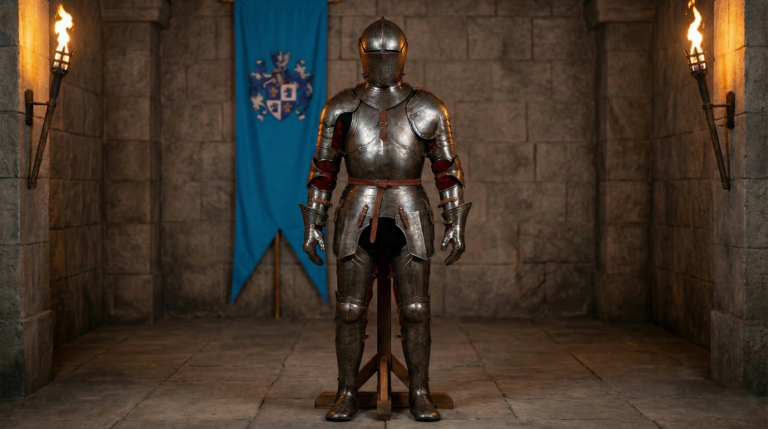
Understanding the specialized terminology of medieval armor is essential for collectors, enthusiasts, and historians. This guide explores six fundamental terms that describe key structural and protective elements of plate armor, from the engineering innovations that allowed movement to the specific components that protected vulnerable areas of the body.
Articulation
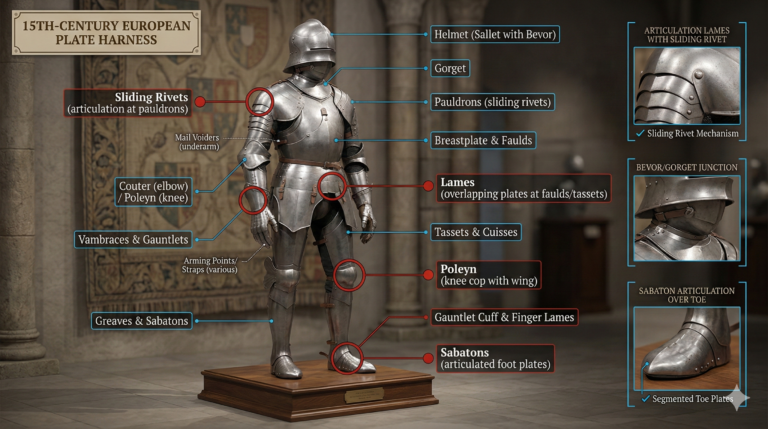
Articulation refers to the sophisticated system of joints and connections in plate armor that allowed the wearer to move freely while maintaining protective coverage. This engineering innovation was one of the most significant developments in armor design, transforming heavy, rigid protection into flexible defensive systems.
The development of articulated plate armor emerged in the late medieval period as armorers sought to balance the competing demands of protection and mobility. Armourers developed sophisticated skills in articulating the lames, or individual plates, particularly for body parts that required flexibility such as elbows, shoulders, knees, and hips.
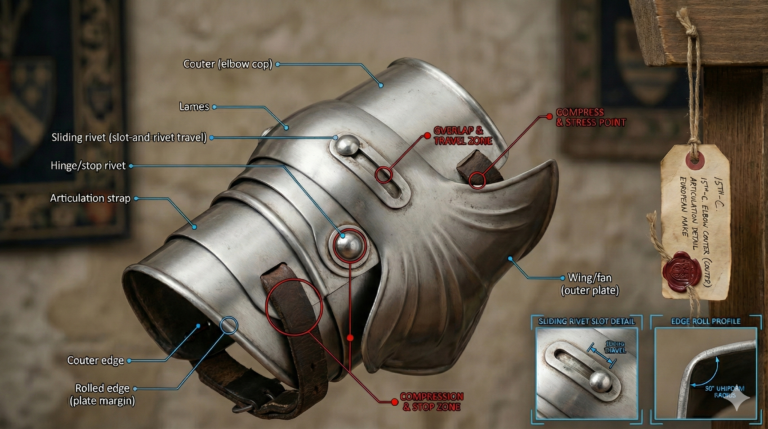
By the late 15th century, articulation had become central to armor design, with sophisticated joint constructions featuring hinges and sliding plates that allowed armor parts to move over each other, similar to fish scales. This advancement enabled knights to perform complex maneuvers including mounting horses, wielding weapons, and engaging in close combat without sacrificing protection.
The articulation points in well-designed armor were carefully oriented to the anatomical axis of rotation of the wearer’s joints, ensuring smooth motion curves without compromising structural integrity. This biomechanical consideration represented a sophisticated understanding of both human anatomy and mechanical engineering.
Lames
Lames (pronounced “lahms”) are the individual solid pieces of sheet metal that form larger sections of articulated plate armor. The term comes from the French word for “blade” or “strip,” reflecting their typically narrow, rectangular shape.
Multiple lames are riveted together or connected by leather straps or cloth lacing to create articulated armor sections that provide flexible protection. This construction method allowed armor to bend and flex at critical points while maintaining continuous coverage.

Lames were used throughout plate armor construction but were particularly important in areas requiring frequent movement. Common applications included faulds (protecting the waist and hips), tassets (thigh protection), and gauntlets (hand protection). The size and number of lames varied depending on the body area being protected and the degree of flexibility required.
The strategic use of lames was not limited to European armor. Japanese samurai armor extensively employed lames (called “ita” in Japanese) in the construction of many armor components, demonstrating the universal recognition of this effective design principle.
Rivets
Rivets are the metal fasteners that held armor components together, playing a crucial structural role in both plate armor and earlier forms of protection. These simple but effective fasteners consisted of short metal rods that were hammered into pre-drilled holes and deformed on the opposite side to secure them in place.
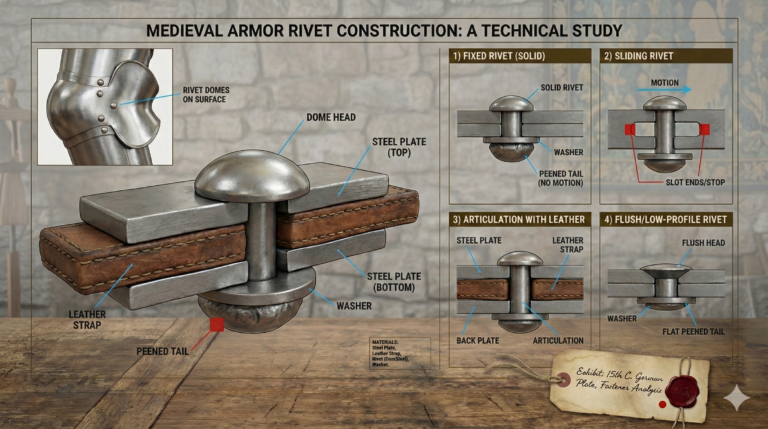
Solid rivets are among the oldest types of fasteners, with archaeological evidence dating back to the Bronze Age. In medieval armor construction, rivets were often made of copper or brass rather than iron, as these metals were easier to work with and more resistant to corrosion.
Rivets served multiple functions in armor construction. They connected metal plates to each other, attached plates to leather backing in brigandine armor, and created pivot points in articulated joints. In some armor types, the term “rivet” became synonymous with the armor itself, as in the “Almain rivet,” a type of flexible German plate armor from around 1500 characterized by overlapping plates sliding on rivets.
In brigandine armor, the rivets were often decorative as well as functional, being gilt or made of latten (a brass-like alloy) and sometimes embossed with designs. The contrast between richly dyed fabric and gilded rivet heads made such armor popular with high-status individuals.
For collectors evaluating armor, rivet condition is critical. Missing or damaged rivets compromise the structural integrity of armor, as the force from impacts cannot be properly distributed across the plates.
Besagews
Besagews (also spelled besagues or rondels) are small, typically circular or oval plates designed to protect one of the most vulnerable areas of plate armor: the armpits. These defensive elements emerged as armorers sought solutions to protect the exposed mail or gaps at articulation points.
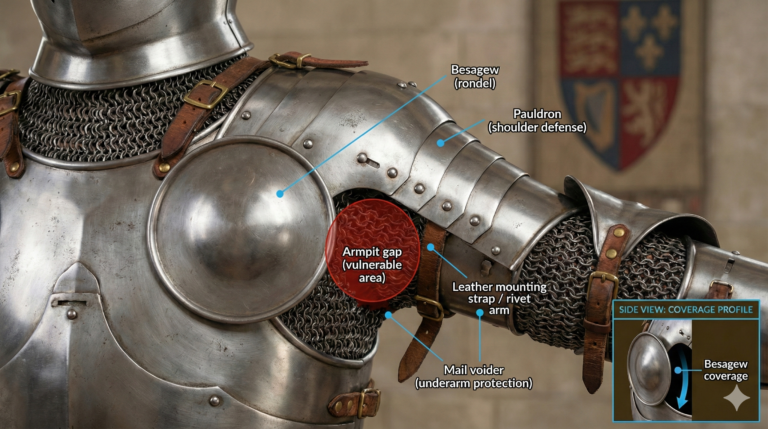
The armpit area, known by the French term “défaut de la cuirasse” (weakness of the cuirass), presented a persistent vulnerability in armor design. Before the development of besagews, this area was typically protected only by the mail shirt worn beneath the plate armor, making it a prime target for thrusting weapons.
Besagews were particularly associated with Gothic armor, though they appeared in various armor styles throughout Europe. They were typically mounted on or near the pauldrons (shoulder guards) and positioned to cover the armpit gap when the arm was in different positions.
The design of besagews often incorporated decorative elements while maintaining functionality. Some besagews featured radiating fluting patterns, which served both aesthetic and structural purposes by adding rigidity to the thin plate.
In full suits of plate armor, besagews worked in conjunction with wings on couters and poleyns to provide comprehensive protection for vulnerable joint areas, representing the culmination of defensive armor engineering.
Couters
Couters (also spelled cowters) are the armor components specifically designed to protect the elbows. These crucial defensive elements evolved from simple curved plates into sophisticated articulated joints that allowed full range of motion while maintaining protection.
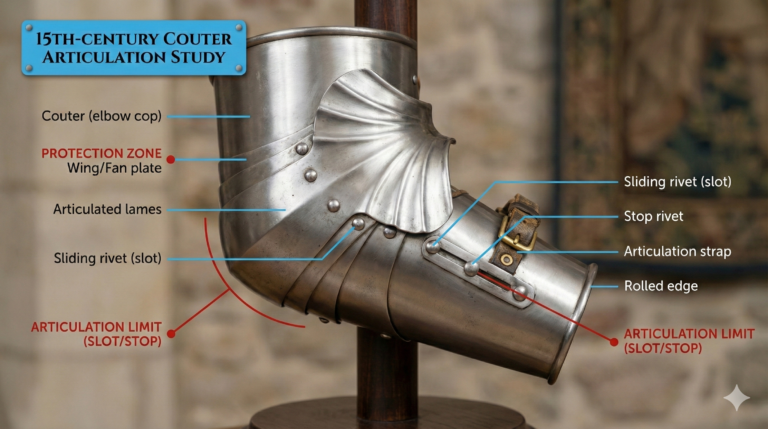
Early couters were relatively simple curved pieces of metal that covered the elbow joint. As plate armor technology progressed, couters became articulated joints, incorporating multiple plates that could move relative to each other, allowing the arm to bend freely.
Couters typically featured pointed shapes that accommodated the natural bend of the elbow, with the point extending beyond the joint to provide additional protection and deflect blows. More advanced couters incorporated “wings” or side plates that protected the inside of the elbow joint, addressing the same vulnerability concerns that prompted the development of besagews.
The couter connected the upper arm defense (rerebrace) to the lower arm defense (vambrace), creating a continuous protective system for the entire arm. The articulated form of couters allowed for the complexity of movement required for combat, enabling knights to wield weapons effectively while maintaining arm protection.
In a complete suit of plate armor by around 1420, couters were standard components, integrated into the overall defense system that covered the warrior from head to toe.
Tassets
Tassets are plate armor components designed to protect the upper thighs and hips. These articulated defenses hung from the fauld or cuirass and consisted of multiple lames that allowed movement while providing coverage for an area particularly vulnerable in mounted combat.

Tassets attached to the cuirass and protected the upper thighs, particularly from attacks from above, making them especially important for mounted knights who faced enemies striking upward. The typical construction featured overlapping lames that could flex with the wearer’s movement.
The appearance of tassets marked an important development in armor design. In Gothic style armor appearing around 1440, tassets hung from the taces (horizontal bands around the waist), often ending in a point toward the lower edge. This design evolved throughout the 15th century as armorers refined the balance between protection and mobility.
In the Dos Aguas armor from Valencia, Spain, the tassets were composed of three lames, with each inner edge turned outward at right angles. This design feature provided additional structural strength through the creation of continuous arch-shaped flanges.
While tassets protected the upper legs from above, cuisses provided protection from below, with these two components working together to provide comprehensive leg defense. The strategic use of tassets reflected the practical combat considerations of medieval warfare, where the vulnerability of mounted combatants to upward strikes required specialized protection.
In some armor types, such as the Almain rivet, tassets were integral components of the basic armor kit, serving as laminated thigh-guards that exemplified the efficient, mass-producible armor designs of the early 16th century.
Sources and Further Reading
- Edge, David, and Paddock, John Miles. Arms & Armor of the Medieval Knight. New York: Crescent Books, 1988.
- “Plate armour.” Wikipedia, October 4, 2025.
- “Lame (armor).” Wikipedia, February 28, 2025.
- “List of medieval armour components.” Wikipedia, September 3, 2025.
- “The Role of Articulated Joints in Late Medieval Plate Armor.” Sabatons.com, February 1, 2025.
- “Plate Armor in Europe: An Analysis.” Battle-Merchant.
- “Plate Armor: Materials and Techniques.” Battle-Merchant.
- “Medieval Armor Systems: Materials, Fabrication, and Functional Performance.” The Action Elite.
- “Knight’s Plate Armor.” Medieval Collectibles, August 24, 2022.
- “Plate armor with articulations emerged in the 15th century.” Medieval-Spell.com.
- “The Emergence and Development of Plate Armor from the Medieval Period.” Brewminate, March 31, 2024.
- “Rivet.” Wikipedia, September 18, 2025.
- “Almain rivet.” Wikipedia, April 17, 2024.
- “Brigandine.” Wikipedia.
- “White armour.” Wikipedia, July 25, 2025.
- “German Gothic Armour.” Wallace Collection.
- “Parts Of Medieval Armor: A Complete Guide To Pieces, Their Function, And Historical Evolution.” Medieval-Shop, August 27, 2025.
- “Plate armour maintenance.” Steel Mastery.
- Life in the Realm of Fantasy. “Medieval armor.”
Note for Collectors: This page is intended as an educational resource for understanding armor terminology. When evaluating historical pieces or replicas, always verify authenticity through expert consultation and examination of construction details, materials, and provenance.