
Anatomy of Medieval & Fantasy Weapons: Understanding Every Component
Home » Glossary » Terminology Hub » Anatomy of Medieval & Fantasy Weapons: Understanding Every Component
Anatomy of Medieval & Fantasy Weapons: Understanding Every Component
Mastering weapon terminology transforms casual observers into knowledgeable collectors, historians, and enthusiasts. Every component of a medieval weapon serves a specific purpose, from the smallest decorative element to the most critical structural feature. This comprehensive guide dissects the anatomy of swords, axes, polearms, maces, daggers, and ranged weapons, providing the technical vocabulary essential for authentic discussion, accurate identification, and informed collecting.
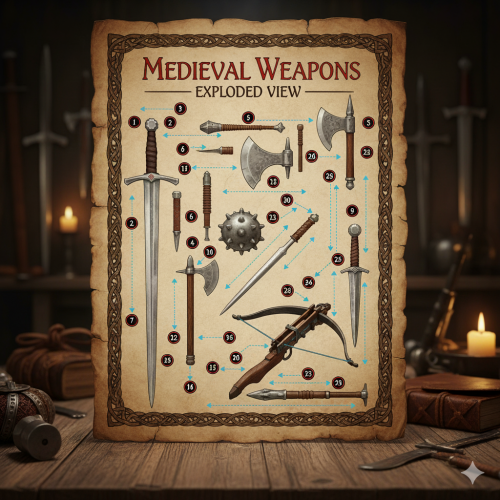
The Universal Language of Weapon Construction
Before exploring specific weapon types, certain terms apply across multiple categories. Understanding these foundational concepts provides the framework for more specialized knowledge.
Core Structural Elements
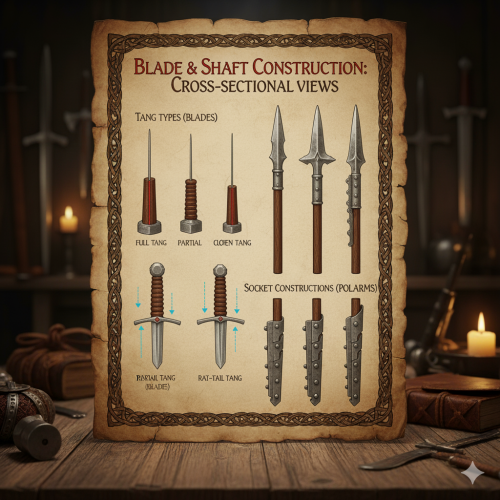
Tang: The extension of the blade or head that extends into the handle, critical for weapon integrity. According to the Royal Armouries, tang construction often determines whether a weapon is decorative or functional. Full tangs extend through the entire handle, while partial tangs may only reach halfway. Rat-tail tangs narrow significantly, while hidden tangs disappear entirely within the grip.
Haft/Hilt: The complete handle assembly of any weapon. In swords, this includes the grip, pommel, and guard. For axes and hammers, the haft refers to the wooden or metal handle. The Metropolitan Museum of Art’s Arms & Armor Department notes that hilt design often indicates geographical origin and intended use.
Socket: The receptacle where blade meets handle or head meets haft, crucial for weapon durability. Socketed designs distribute force more evenly than tanged constructions, particularly important in impact weapons.
Ferrule: Metal bands or caps reinforcing stress points, preventing wood from splitting. These seemingly minor components, as documented by the Higgins Armory Museum collection, often determine a weapon’s longevity.
Sword Anatomy: The Most Complex Weapon System
Swords represent the pinnacle of medieval weapon complexity, with specialized terminology for every element. The Oakeshott Institute has standardized much of this vocabulary through typological studies.
Blade Components
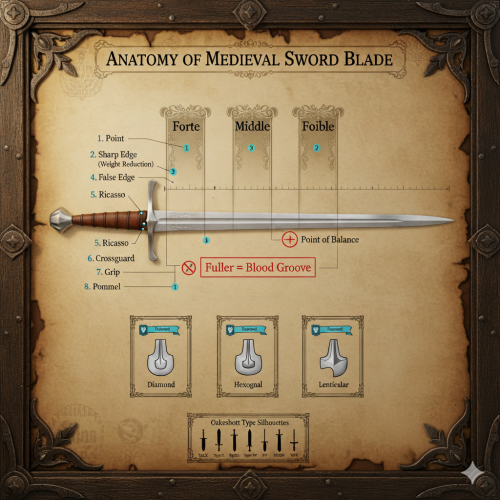
Forte: The strong third of the blade nearest the hilt, optimal for parrying and binding. This section typically features the greatest width and thickness, providing structural strength for defensive actions.
Foible: The weak third toward the point, ideal for cutting and thrusting. Despite the name, this isn’t a weakness but rather describes the mechanical advantage in this blade section.
Fuller: Often misnamed “blood groove,” this central channel reduces weight while maintaining strength. The Wallace Collection explains that fullers follow the same engineering principle as I-beams in construction.
Ridge: The raised central spine on unfullered blades, providing rigidity. Diamond, hexagonal, and lenticular cross-sections each offer different performance characteristics.
Edge: The sharpened cutting surface, which may be single (one-sided) or double (two-sided). Edge geometry varies from acute angles for cutting to obtuse angles for durability.
False Edge: The sharpened back portion near the point on otherwise single-edged blades, improving thrusting capability while maintaining the blade’s primary cutting focus.
Point: The tip designed for thrusting, varying from acute points for armor penetration to spatulate points for cutting-focused designs.
Ricasso: The unsharpened section immediately above the guard, sometimes featuring a maker’s mark. This area allows for finger placement in certain grip techniques.
Hilt Architecture
Cross-guard/Quillons: The perpendicular bar preventing hands from sliding onto the blade while protecting against opponent’s weapons. The Museum of London documents evolution from simple straight guards to complex swept hilts.
Grip/Handle: The holding surface, traditionally wood wrapped in leather, wire, or cord. Grip length determines whether a sword is one-handed, hand-and-a-half, or two-handed.
Pommel: The counterweight at the grip’s end, essential for balance. Pommel shapes (wheel, brazil nut, scent stopper, fishtail) often indicate period and region, as catalogued by the Leeds Royal Armouries.
Chappe/Rain-guard: The leather or metal flap protecting the scabbard mouth from moisture, often overlooked but crucial for blade preservation.
Knuckle-bow: The curved guard protecting the hand, evolving into complex basket hilts. This development, traced by the Glasgow Museums Resource Centre, revolutionized sword combat.
Pas d’âne/Arms of the Hilt: Side rings protecting fingers when wrapped around the ricasso, characteristic of later medieval and Renaissance swords.
Ecusson/Shield: Small plates flanking the blade base, both decorative and protective.

Scabbard Terminology
Throat: The reinforced scabbard opening, usually metal, preventing wear from drawing and sheathing.
Chape: The protective tip preventing scabbard damage and ground penetration. Medieval chapes often feature elaborate decoration indicating owner status.
Suspension System: Includes the belt, frog, hangers, and buckles securing the weapon. The British Museum notes that suspension methods indicate martial tradition and social rank.
Locket: The upper scabbard fitting, often matching the chape in decoration and material.
Axe Anatomy: Power Through Simplicity
Medieval axes combine straightforward design with devastating effectiveness. The Viking Ship Museum provides extensive documentation of historical axe construction.
Head Components
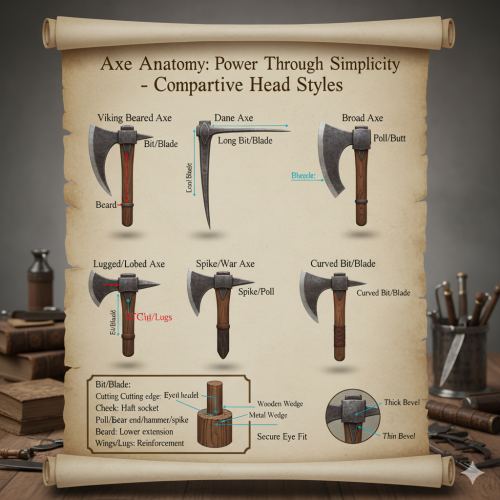
Bit/Blade: The cutting edge, varying from narrow (armor-focused) to broad (general combat). Bearded axes extend the bit below the eye, maximizing cutting surface while minimizing weight.
Cheek: The flat side of the axe head, sometimes reinforced or decorated. Weight distribution here affects balance and striking power.
Eye: The socket receiving the haft, critical for secure mounting. Proper eye construction prevents catastrophic head separation during combat.
Poll/Butt: The back of the head, sometimes extended as a hammer surface or spike. This secondary striking surface adds tactical versatility.
Beard: The extended lower portion of certain axe designs, allowing for hooking techniques and extended cutting surface.
Wings/Lugs: Reinforcements extending from the eye, preventing over-penetration and enabling binding techniques.
Haft Features
Shoulder: The widened section below the head, preventing slippage and providing a secondary grip position.
Throat: The area immediately below the head, subject to greatest stress and often reinforced.
Belly: The curved section providing leverage and shock absorption, particularly pronounced in Danish axes.
Knob/Butt: The haft end, sometimes weighted for balance or capped for durability.
Langets: Metal strips extending from the head along the haft, preventing damage from overstrikes or enemy weapons
Polearm Anatomy: Reach and Versatility
Polearms encompass diverse designs sharing common elements. The Musée de l’Armée categorizes these weapons by their head configurations and tactical applications.
Universal Polearm Elements
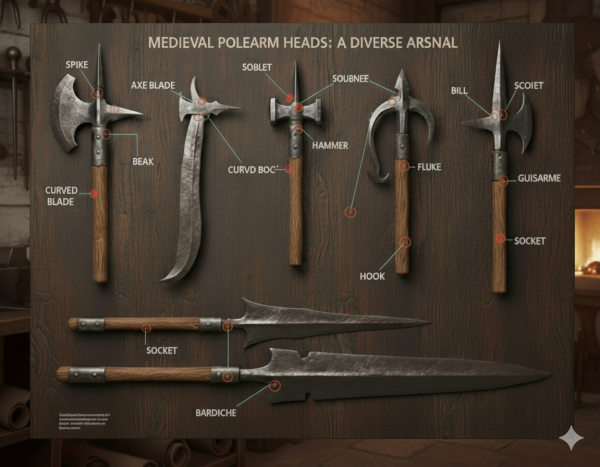
Head: The business end, varying dramatically between weapon types (spear point, axe blade, hammer, hook, or combinations).
Socket: The hollow shaft receiver, usually reinforced with langets extending down the shaft.
Shaft/Staff: The wooden pole, typically 5-8 feet long. Wood selection (ash, oak, bamboo) affects flexibility and durability.
Butt-cap/Ferrule: The reinforced shaft end, enabling ground-planting and secondary striking.
Specialized Polearm Features
Bill Hook: The pronounced hook for dismounting cavalry, characteristic of bills and halberds.
Bec de Corbin/Raven’s Beak: The armor-piercing spike opposite the primary blade, common on lucerne hammers.
Fluke: The pronged back-spike on certain poleaxes, designed for penetration and control.
Wings/Rondels: Perpendicular projections preventing over-penetration, allowing for pushing and binding techniques.
Partisan Blades: The secondary blades flanking a spear point, characteristic of partisans and spontoons.
Queue/Tail: The reinforced joint between head and shaft, often the weapon’s weakest point.
Mace & Hammer Anatomy: Percussive Power
Impact weapons rely on mass concentration and energy transfer. The Tower of London collection demonstrates evolution from simple clubs to sophisticated armor-defeating designs.
Head Configurations
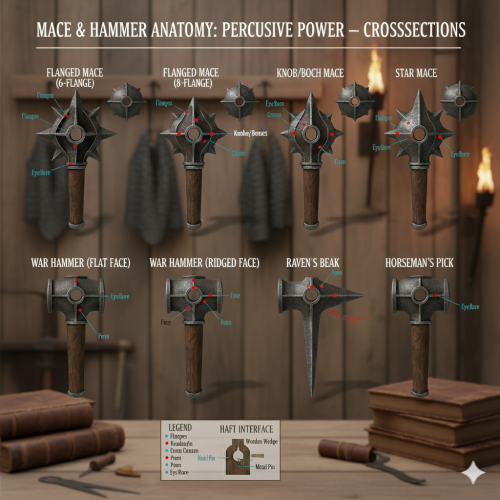
Flanges: The pronounced ridges on mace heads, concentrating impact force. Numbers vary from four to twelve, with six or eight being most common.
Knobs/Bosses: Rounded projections on primitive maces, less effective against armor than flanged designs.
Crown: The top striking surface, sometimes featuring a spike for thrusting capability.
Face: The striking surface of war hammers, usually small to concentrate force for armor penetration.
Peen: The back spike or claw of war hammers, designed for puncturing or grappling.
Handle Elements
Grip: Often wrapped in leather or cord, sometimes featuring finger grooves for security.
Disc Guard: The circular plate protecting the hand, particularly common on Eastern maces.
Wrist Loop/Thong: Leather cord preventing weapon loss, essential for mounted combat.
Counterweight: Internal weight distribution optimizing striking power, documented in the Germanisches Nationalmuseum collections.
Dagger Anatomy: Precision in Miniature
Daggers share sword terminology but include specialized features. The Victoria and Albert Museum notes that dagger design often indicates social context beyond martial application.
Blade Specifics
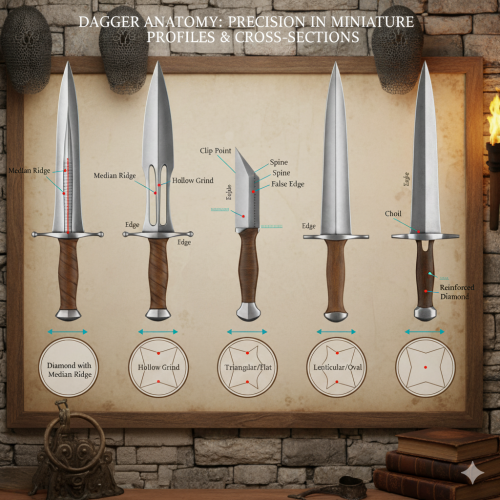
Median Ridge: The central reinforcement crucial in thrusting-focused designs like rondel daggers.
Hollow Grind: The concave blade surface reducing weight while maintaining edge geometry.
Clip Point: The false edge creating an acute point, characteristic of certain fighting knives.
Choil: The unsharpened section allowing finger placement ahead of the guard for precise control.
Guard Variations
Rondel: The disc-shaped guards giving the rondel dagger its name, providing excellent hand protection.
Quillons: Straight or curved crossguards, sometimes elaborate in parrying daggers.
Shell Guard: The cup-shaped protection characteristic of main gauche daggers.
Bolster: The thickened junction between blade and handle, providing strength and balance.
Nagel: The secondary guard projection aiding in trapping and controlling opponent’s weapons.
Ranged Weapon Anatomy: Mechanical Precision
Bows and crossbows employ specialized terminology reflecting their mechanical nature. The Society of Archer-Antiquaries maintains comprehensive documentation of historical archery terms.
Bow Components
Stave/Bow Staff: The wooden body, with belly (facing archer) and back (facing target).
Limbs: The flexible arms storing energy, divided into working and static sections.
Nocks: The grooves at limb tips holding the string, reinforced with horn or bone in quality bows.
Grip/Handle: The central holding area, sometimes wrapped in leather or cord.
Arrow Rest: The shelf or window where the arrow passes, affecting accuracy.
String: Traditionally linen, hemp, or silk, with specific terminology for loops, serving, and nocking points.

Crossbow Mechanisms
Prod/Lath: The bow portion, made from wood, horn, sinew, or steel.
Stock/Tiller: The wooden body containing the mechanism and providing shoulder support.
Nut: The rotating catch holding and releasing the string, the crossbow’s critical mechanism.
Trigger/Tickler: The release lever, varying from simple pivots to complex multi-lever systems.
Stirrup: The front loop for foot placement during spanning, essential for powerful crossbows.
Windlass/Cranequin: Mechanical spanning devices multiplying force for heavy crossbows.
Bolt Groove/Track: The channel guiding projectiles, requiring precise alignment.
Sight Bridge: The rear sight alignment point, sometimes adjustable for range.

Fantasy Weapon Terminology: Where Imagination Meets Function
Fantasy weapons often exaggerate or combine historical elements, creating unique terminology needs. The Fantasy Literature Foundation notes how fictional weapons influence collecting trends.
Hybrid Constructions
Sword-staff: Combining blade and polearm elements, requiring terminology from both categories.
Gun-blade: Integrating firearms with edged weapons, popularized in fantasy gaming.
Chain Weapons: Articulated designs like sword-whips requiring specialized vocabulary for links, joints, and control mechanisms.
Transforming Weapons: Mechanical designs with multiple configurations, each requiring distinct terminology.

Decorative Elements
Runes/Glyphs: Inscribed symbols, whether historical (Viking, Celtic) or fantasy-created.
Power Stones/Gems: Embedded decorations implying magical properties, requiring mounting terminology.
Wrappings: Elaborate grip treatments beyond historical norms, including monster hide, wire art, and fantasy materials.
Aura Channels: Grooves or patterns suggesting energy flow, common in game-inspired pieces.
Material-Specific Terminology
Understanding materials enhances anatomical knowledge. The American Bladesmith Society provides standards for modern reproduction materials.
Steel Components
High Carbon Content: Affects hardness and edge retention, crucial for functional pieces.
Spring Steel: Provides flexibility preventing catastrophic failure, essential for combat-ready weapons.
Pattern Welding/Damascus: Decorative and functional steel layering, creating distinctive patterns.
Case Hardening: Surface treatment providing hard exterior with tough core.

Handle Materials
Ray Skin/Shagreen: Traditional grip wrapping providing texture and moisture resistance.
Wire Wrap: Twisted metal providing grip and decoration, requiring specific winding patterns.
Leather Varieties: From simple cowhide to exotic materials, each with specific properties.
Modern Composites: Micarta, G10, and other synthetic materials in contemporary reproductions.
Construction Method Terminology
How weapons are made affects their terminology. The Worshipful Company of Blacksmiths maintains traditional craft vocabulary.
Forging Terms
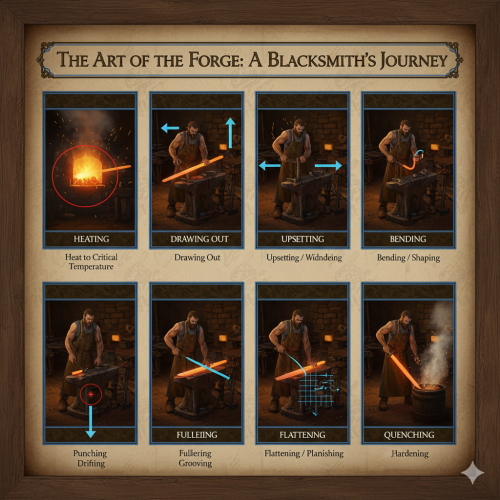
Stock Removal: Grinding blade shape from steel bar, versus traditional forging.
Differential Heat Treatment: Creating hard edges with flexible cores, visible in hamon lines.
Upset Forging: Thickening metal through compression, crucial for strong transitions.
Welded Construction: Joining separate pieces, from traditional fire welding to modern methods.
Assembly Methods
Peened Construction: Mechanically securing components through hammered expansion.
Threaded Tang: Modern assembly method allowing disassembly for maintenance.
Epoxy Setting: Contemporary adhesive methods for permanent assembly.
Pinned/Riveted: Traditional mechanical fastening visible in historical pieces.

Regional Variations in Terminology
Weapon anatomy terms vary across cultures. The Asian Art Museum emphasizes understanding cultural context in terminology use.
Eastern Variations
Tsuba: Japanese sword guard, with specialized terminology for shapes and decorations.
Habaki: Blade collar in Japanese swords, critical for proper mounting.
Kissaki: Japanese sword point geometry, with specific profile classifications.
Dao Terminology: Chinese sword vocabulary differing from Western equivalents.
Regional European Distinctions
Germanic Terms: Parierhaken (parrying hooks), Fehlschärfe (false edge), influencing modern terminology.
Italian Nomenclature: Specific rapier terminology like ricasso, forte, and debole entering common usage.
Iberian Variations: Unique terminology for specific designs like the falcata and montante.
Condition & Quality Descriptors
Anatomical knowledge includes understanding condition terminology. The International Association of Museums provides conservation vocabulary standards.
Blade Conditions
Patina: Surface oxidation indicating age or use, varying from desirable to problematic.
Pitting: Corrosion damage creating surface irregularities, affecting both aesthetics and function.
Set: Permanent blade bending from stress, distinct from designed curves.
Grind Lines: Visible transitions between blade geometry changes, indicating construction quality.

Handle Deterioration
Checking: Wood cracking from age or moisture changes, potentially affecting structural integrity.
Looseness: Component movement indicating wear or assembly failure.
Wrap Degradation: Leather, cord, or wire damage affecting grip security and appearance.
Tang Corrosion: Hidden damage potentially compromising weapon integrity.
Modern Collector Terminology
Contemporary collecting introduces new anatomical vocabulary. The Arms & Armor Society of America documents evolving terminology standards.
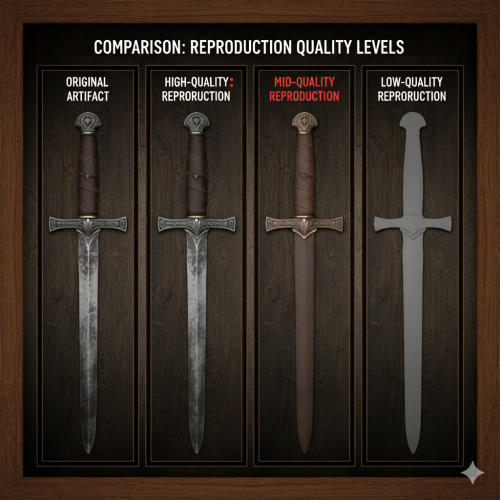
Reproduction Classifications
Battle-Ready: Full tang, proper heat treatment, and historical weight distribution.
Display Quality: Accurate appearance with potential structural compromises.
Stage Combat: Reinforced edges and points for theatrical safety.
Museum Quality: Exacting reproduction of specific historical pieces.
Technical Specifications
Point of Balance: Distance from guard affecting handling characteristics.
Harmonic Nodes: Vibration points indicating construction quality.
Distal Taper: Blade thickness reduction toward point, crucial for proper handling.
Profile Taper: Width reduction affecting both aesthetics and performance.
Measurement Standards
Precise measurement terminology ensures accurate communication. The Oakeshott Institute provides standardized measurement protocols.
Standard Measurements
Overall Length: Complete weapon measurement including all components.
Blade Length: From guard to point, excluding handle.
Cutting Edge: Actual sharpened length, potentially different from blade length.
Handle Length: Grip area only, excluding pommel and guard.
Width at Guard: Maximum blade width, indicating weapon type and period.

Understanding Maker's Marks
Anatomical knowledge includes recognizing signature locations. The British Museum catalogs historical maker’s marks and their placement conventions.
Mark Locations
Ricasso Stamps: Traditional placement for smith signatures and guild marks.
Tang Signatures: Hidden marks revealed only during disassembly.
Pommel Engravings: Owner or smith identification, sometimes indicating date.
Fuller Inscriptions: Religious or personal mottos running blade length.
Practical Application of Anatomical Knowledge
Understanding weapon anatomy enables:
- Accurate Identification: Distinguishing authentic pieces from reproductions
- Informed Purchasing: Recognizing quality indicators and potential issues
- Proper Maintenance: Understanding how components interact and wear
- Historical Research: Correlating design features with period and culture
- Effective Communication: Speaking knowledgeably with dealers, collectors, and scholars
The College of Arms notes that proper terminology usage indicates serious scholarship and collecting intent.
Continuing Education
Weapon anatomy knowledge constantly expands through:
- Archaeological Discoveries: New finds revealing unknown construction methods
- Scientific Analysis: X-ray and metallurgical studies exposing hidden features
- Experimental Archaeology: Reproduction attempts teaching practical terminology
- Cross-Cultural Exchange: Global collecting community sharing regional vocabulary

Mastery Through Understanding
Every rivet, fuller, and ferrule tells a story of martial innovation, artistic expression, and technical evolution. This anatomical vocabulary transforms weapons from simple objects into readable texts documenting human ingenuity across centuries. Whether examining a Viking sword’s simple efficiency or a Renaissance rapier’s complex hilt, anatomical knowledge reveals the thought, skill, and purpose embedded in every component.
From the smallest decorative detail to the most critical structural element, understanding weapon anatomy enriches every aspect of collecting, studying, and appreciating medieval arms. This technical vocabulary serves as your foundation for deeper exploration into the fascinating world of historical and fantasy weapons.
This comprehensive guide to weapon anatomy draws from museum collections, academic research, and expert craftspeople worldwide. For corrections or additions, please contact our editorial team.
Related Glossary Sections: